Search is entering a new phase. Instead of listing links, modern interfaces generate answers.
AI systems now summarise categories, compare tools, and explain concepts before users ever visit a website. The first interaction is no longer a results page; it’s an explanation.
This changes how visibility works.
Ranking alone is no longer enough. Increasingly, influence depends on whether your brand is included in the answers themselves.
That new layer is what AI Search Visibility is about.
What is AI search
AI search refers to search experiences where artificial intelligence generates answers instead of returning a list of links.
The system still relies on web sources, but instead of acting like a directory, it behaves like an interpreter. It retrieves information, understands intent, and produces a synthesized explanation.
In traditional search, users stitched knowledge together manually. They opened multiple tabs, compared sources, and built an understanding step by step.
AI search compresses that process.
The model retrieves relevant content, evaluates it, and produces a combined explanation that may include summaries, comparisons, and recommendations.
Search shifts from navigation to interpretation. From finding information to understanding it instantly.
Why AI search is becoming important
User behavior has evolved from fragmented keywords to complete questions. As AI systems improve at reasoning and summarization, people increasingly expect direct answers instead of research workflows.
This compresses the discovery journey.
Understanding and evaluation now happen earlier, often inside the AI interface itself. The brands mentioned in that first answer shape how users perceive the entire category.
In this environment, visibility shifts.
It’s no longer just about where you rank. It’s about whether you’re included at all.
AI search introduces a new layer of influence that sits above traditional rankings.
LinkedIn’s B2B team saw non‑brand awareness traffic for some topics fall by nearly 60% after Google’s AI Overviews rolled out, even though rankings barely moved. The answers shifted into the AI box, so users got what they needed before ever clicking through – a clear example of visibility changing inside the AI layer, not on the results page.
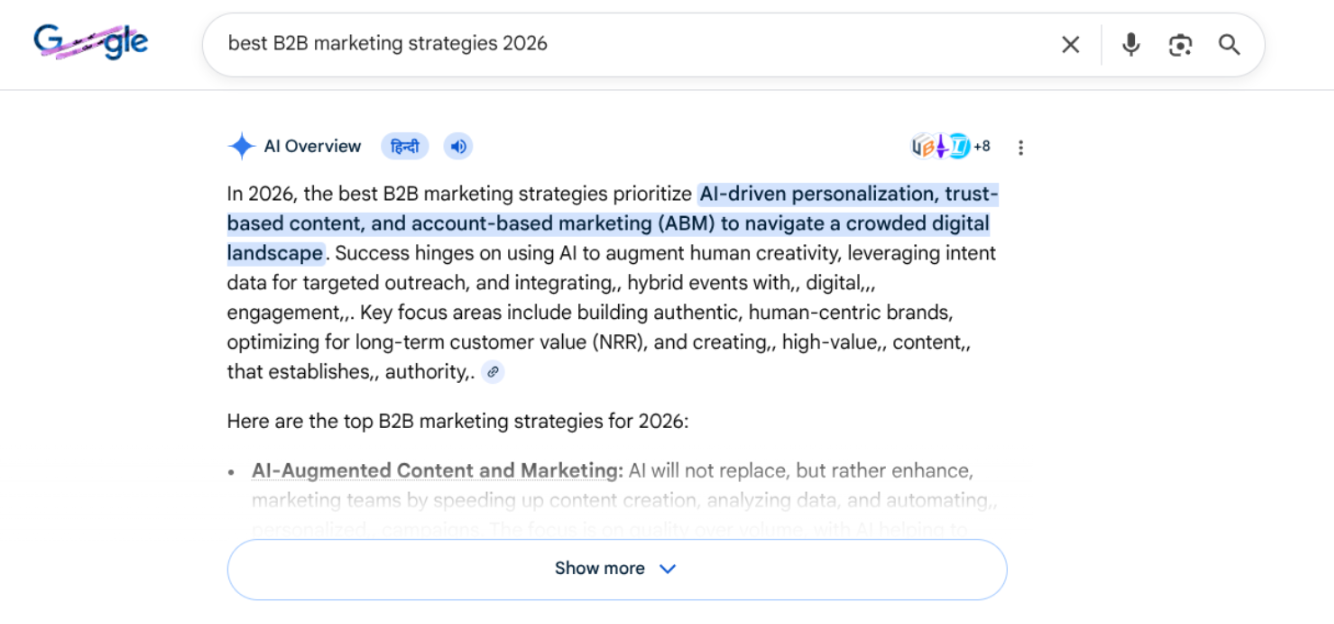
Google AI Overview delivers complete B2B strategy answers users rarely scroll to organic results below. This is exactly why traffic drops even when brands appear in AI citations.
Where AI search is appearing today
AI search is not limited to a single platform. It is emerging across multiple ecosystems where generative intelligence is layered on top of information retrieval.
You can see it in generative search features inside traditional engines, answer-first AI tools, and copilots embedded into everyday software.
Different interfaces. Same pattern.
AI retrieves information and presents a synthesized interpretation before users explore deeper. The first interaction is no longer a list it’s a narrative.
And that narrative shapes perception.
Types of AI search systems
AI search is not built in one uniform way. Different platforms use different architectures, and these differences affect how visibility works.
Type | How it works | Visibility driver |
Answer engines | Direct conversational responses | Clarity + topical authority |
Generative overlays | AI summaries on top of search | SEO + entity credibility |
Hybrid systems | Retrieval + generative reasoning | Consistency + context depth |
Answer engines
Answer engines generate direct responses to user prompts. Instead of offering links, they synthesize information into a complete answer.
These systems behave more like knowledge assistants than search engines. The goal is resolution, not exploration.
Visibility here depends heavily on clarity and authority. If your information is easy to interpret and reinforced across sources, inclusion becomes more likely.
Generative search engines
Generative search engines sit on top of traditional search infrastructure. They still retrieve ranked web results, but they generate summaries before users interact with links.
In these environments, AI acts as a summarization layer. It interprets top sources and condenses them into a structured overview.
Visibility becomes hybrid. Rankings still matter, but entity clarity and credibility matter just as much.
Hybrid AI search systems
Some platforms combine elements of both approaches. These hybrid systems blend structured retrieval with generative reasoning to produce grounded yet conversational outputs.
They often combine indexing, knowledge graphs, and language models to balance factual accuracy with readability.
Visibility in hybrid systems typically favors brands with strong positioning, consistent messaging, and broad contextual relevance.
From rankings to citations
Traditional search was built around positions. Visibility was defined by where a page appeared in ranked results, and higher placement typically translated into more clicks and traffic.
AI search changes this dynamic. Instead of presenting ranked lists, AI systems assemble answers by selecting and citing sources that support a synthesized explanation. This makes inclusion within generated responses the new form of visibility.
In this model, ranking reflects placement, while citation reflects trust. A page might rank well yet never be mentioned in AI-generated answers. At the same time, a brand with strong topical authority may appear repeatedly in AI responses even without dominating traditional search results.
Some industry thinkers describe this transition as a move from positional visibility to probabilistic visibility, where brands are no longer guaranteed placement but instead compete for the likelihood of citation within AI-generated answers.
This shift introduces a citation-driven visibility layer where influence depends on being referenced inside the answers users consume.
In one analysis of Google’s AI Mode, LinkedIn was cited in around 15% of AI answers, making it one of the most frequently referenced domains alongside YouTube.[web:2] That citation share told a truer story about its influence in AI responses than its average blue‑link position.
Traditional SEO vs AI Search Visibility
AI Search Visibility is not a replacement for SEO. It operates one layer above it. Traditional SEO is built around ranking mechanics, keyword optimization, crawlability, and traffic acquisition. Its primary objective is to increase impressions and clicks from search result pages.
AI Search Visibility, by contrast, focuses on whether your brand is incorporated into AI-generated summaries that influence users before they scroll or click.
The structural difference becomes clear when comparing objectives:
Dimension | Traditional SEO | AI Search Visibility |
Primary Focus | Ranking position | Inclusion in AI answers |
Success Metric | Traffic and CTR | Mentions and narrative framing |
Optimization Target | Keywords and backlinks | Topical authority and clarity |
Value Delivered | Discoverability | Recommendation influence |
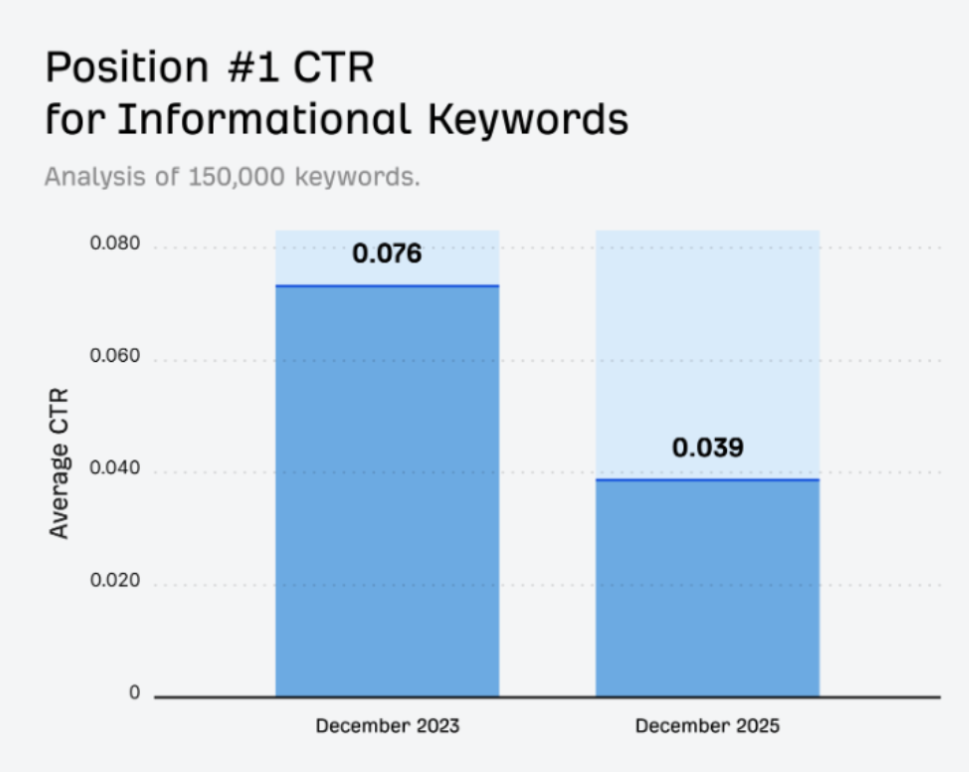
A website can rank highly and still be excluded from AI summaries. Conversely, a brand with strong topical authority and clear positioning may consistently appear in AI responses, even if it does not dominate traditional rankings.
What is AI search visibility?
AI Search Visibility refers to how often and how accurately a brand appears within AI-generated responses.
Instead of measuring where a page ranks, it measures whether a brand becomes part of the answers users receive.
There are three core dimensions.
Presence — whether your brand appears at all. If you’re not included, you’re invisible in that layer.
Prominence — how central your brand is within the response. Being highlighted versus briefly mentioned creates a very different perception.
Accuracy — how correctly you are represented. Misaligned descriptions can distort positioning even when you are included.
Together, these shift the focus from traffic acquisition to narrative participation.
AI Search Visibility is ultimately about being part of the explanation.
How AI systems decide what to cite
AI systems follow a multi-step process: retrieval, evaluation, and synthesis. The evaluation stage largely determines which brands are included.
A clear structure makes content easier to extract. Pages with logical hierarchy and concise explanations are more interpretable than dense text.
Topical depth also matters. Consistent coverage across related subjects signals expertise and improves confidence during synthesis.
Entity clarity reduces ambiguity. When naming, positioning, and messaging stay consistent across sources, models can interpret a brand more reliably.
External validation reinforces credibility. Independent mentions and third-party descriptions strengthen trust signals.
Finally, relevance to the query remains critical. Even authoritative sources may be excluded if they don’t match the user’s intent.
What gets cited and what doesn’t
Early patterns suggest that AI visibility is not evenly distributed. Instead, citations tend to concentrate around a smaller group of brands.
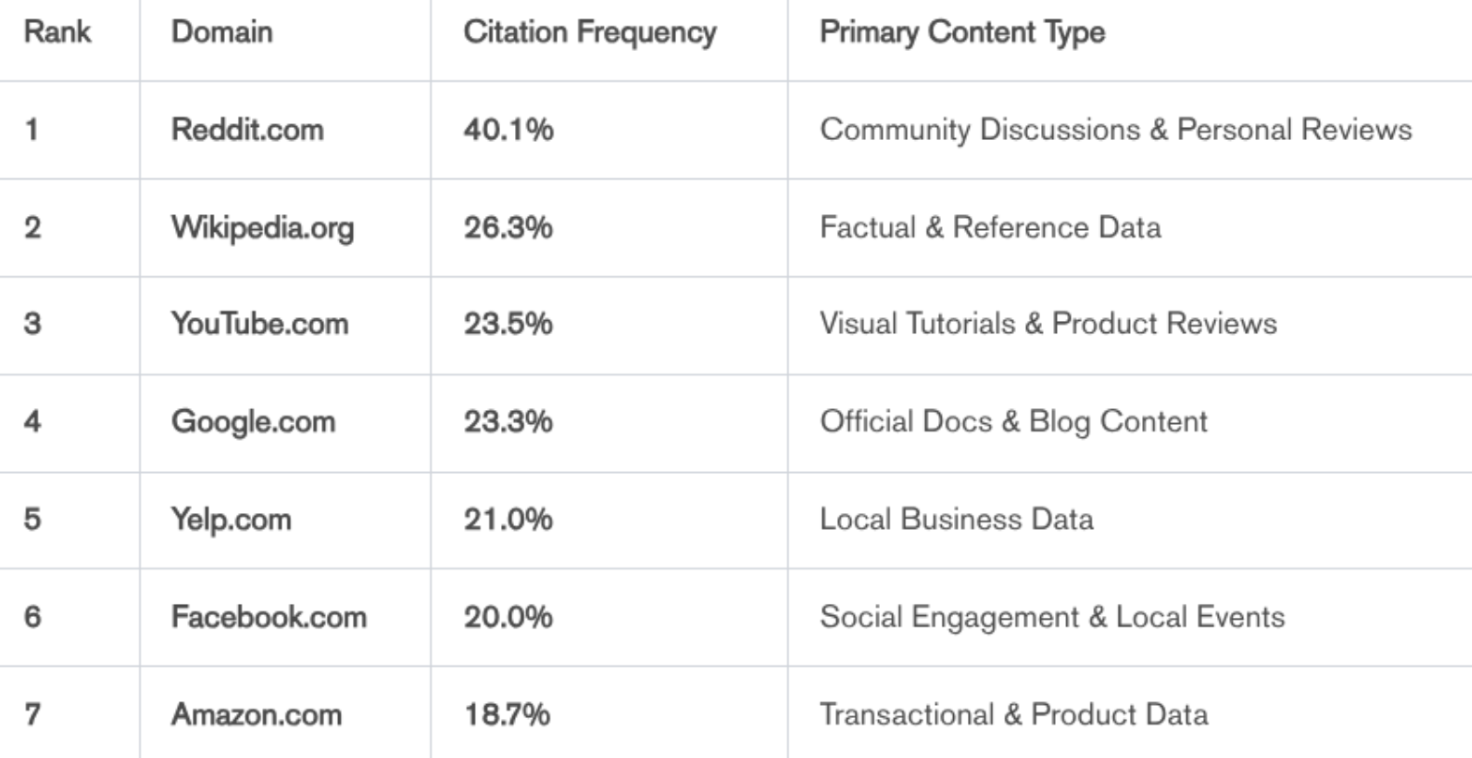
Reddit leads AI citations at 40%, Wikipedia 26% – top 5 sites capture 2/3rds of all mentions. Authority + consistency compounds visibility over time.
Brands that appear more frequently usually have strong third-party validation, deeper topical coverage, and consistent positioning across sources. Reviews, authority mentions, and clear messaging reinforce their inclusion across prompts.
On the other hand, brands that struggle to appear often lack external validation or present inconsistent messaging. Thin content depth, missing comparisons, and unclear positioning make it harder for AI systems to include them confidently.
The concentration is real. A relatively small percentage of brands capture a large share of AI citations, and once inclusion begins, visibility tends to compound over time.
New ways to measure visibility
Because AI search operates differently from traditional search, measurement also needs to evolve. Rankings and click-through rates provide only a partial view of performance in an answer-first environment.
Instead, evaluation shifts toward understanding how often a brand appears and how it is framed. Citation frequency becomes an important indicator of overall presence, while narrative position reveals whether a brand is perceived as a leader, an alternative, or a niche option.
As emerging research on large language models suggests, responses are inherently probabilistic rather than deterministic, meaning the same prompt can generate different outputs across sessions. This makes AI visibility less about fixed rankings and more about repeatability and likelihood of inclusion.
Depth of mention also matters. Being described in detail signals stronger inclusion than being listed briefly. Representation accuracy helps identify whether the AI’s portrayal aligns with reality, while consistency across platforms shows how stable the brand narrative is.
These newer measurement approaches focus less on traffic and more on perception within AI-generated knowledge layers.
What early observations show
Although AI Search Visibility is still emerging, early patterns are forming.
One clear trend is decoupling from rankings. Some brands appear consistently in AI answers without dominating search results.
Another pattern is concentration. A small set of brands tends to appear repeatedly across prompts, creating compounding visibility effects.
There are also signs of narrative reinforcement. When multiple sources describe a brand consistently, AI systems grow more confident in that framing, increasing the likelihood of future citations.
AI visibility behaves less like a fixed ranking system and more like an evolving influence layer.How to improve AI search visibility
Improving AI Search Visibility requires alignment across clarity, consistency, and authority. Gains come from strengthening multiple signals over time.
Strengthen the foundation
Clear technical structure reduces ambiguity. Consolidate duplicate pages, maintain consistent entity definitions, and structure documentation logically.
Build topical depth through interconnected content that strengthens subject authority. Well-structured sections with direct explanations improve extractability and citation likelihood.
Build external validation
External signals reinforce credibility. When independent platforms describe your brand consistently, AI systems gain confidence in including you.
Focus on collecting reviews systematically, earning mentions in authoritative publications, and maintaining consistent positioning across platforms.
Scale with systems
Growing visibility requires systems, not one-off efforts.
Teams are increasingly using tools that track citation patterns across prompts and platforms, turning AI visibility into a measurable layer. Platforms like Serplock help operationalize this by monitoring inclusion trends and surfacing positioning gaps.
Serplock tracks AI mentions, citation frequency, brand positioning, and Reddit conversations across 100+ prompts/models.
Over time, structured monitoring enables teams to iterate strategically rather than relying on guesswork.
Because AI systems synthesize signals across sources, improvements compound gradually.
Managing AI visibility as a system
As AI search evolves, visibility management is becoming an ongoing discipline rather than a one-time optimization.
Many teams now treat AI visibility as a system that requires monitoring, analysis, and iteration. This includes tracking inclusion across controlled prompts, auditing consistency across web properties, and evolving content alongside user intent.
Structured monitoring helps identify shifts in how AI systems describe categories and where positioning adjustments are needed.
Approaching AI Search Visibility as a continuous system makes it easier to adapt as models evolve.
Conclusion
AI search represents a structural shift in how information is discovered and understood.
As answers increasingly replace lists of links, visibility becomes tied to inclusion rather than position alone.
AI Search Visibility captures this shift by focusing on whether a brand is present, how prominently it appears, and how accurately it is represented. It reframes search from a ranking contest into a participation model where influence depends on being part of the narrative that shapes understanding.
Traditional SEO still ensures discoverability. AI Search Visibility determines whether that discoverability translates into presence within the answers users rely on.
Together, they define how brands compete in an era where perception is shaped before the first click.