Search visibility today isn't just about keywords or backlinks it's about whether your content deserves to be trusted. E-E-A-T (Experience, Expertise, Authoritativeness, and Trustworthiness) is Google's framework for judging content quality at scale.
Originally a three-part framework called E-A-T, Google added a fourth dimension — Experience — in December 2022. This was announced directly on the Google Search Central Blog. If your strategy still references only "E-A-T," it's outdated.
What is E-E-A-T?
E-E-A-T stands for Experience, Expertise, Authoritativeness, and Trustworthiness. These are the four dimensions Google uses to assess content quality in its Search Quality Evaluator Guidelines, a publicly available document (currently over 160 pages) that Google's contracted human raters use to evaluate search results.
One critical clarification most guides miss:
E-E-A-T is not a direct ranking factor or a score. It is a conceptual framework used in Google's Quality Rater Guidelines to evaluate how well Google's ranking systems are working.
Google doesn't compute an "E-E-A-T score" and plug it into an algorithm. Instead, human raters use this framework to assess quality, and those assessments inform how ranking systems are refined over time. This distinction matters, it means you can't "optimise for E-E-A-T" directly. You build it.
According to Google, Trust is the most important member of the E-E-A-T family. The guidelines state that untrustworthy pages have low E-E-A-T no matter how experienced, expert, or authoritative they may seem. The other three dimensions all feed into and reinforce trust.
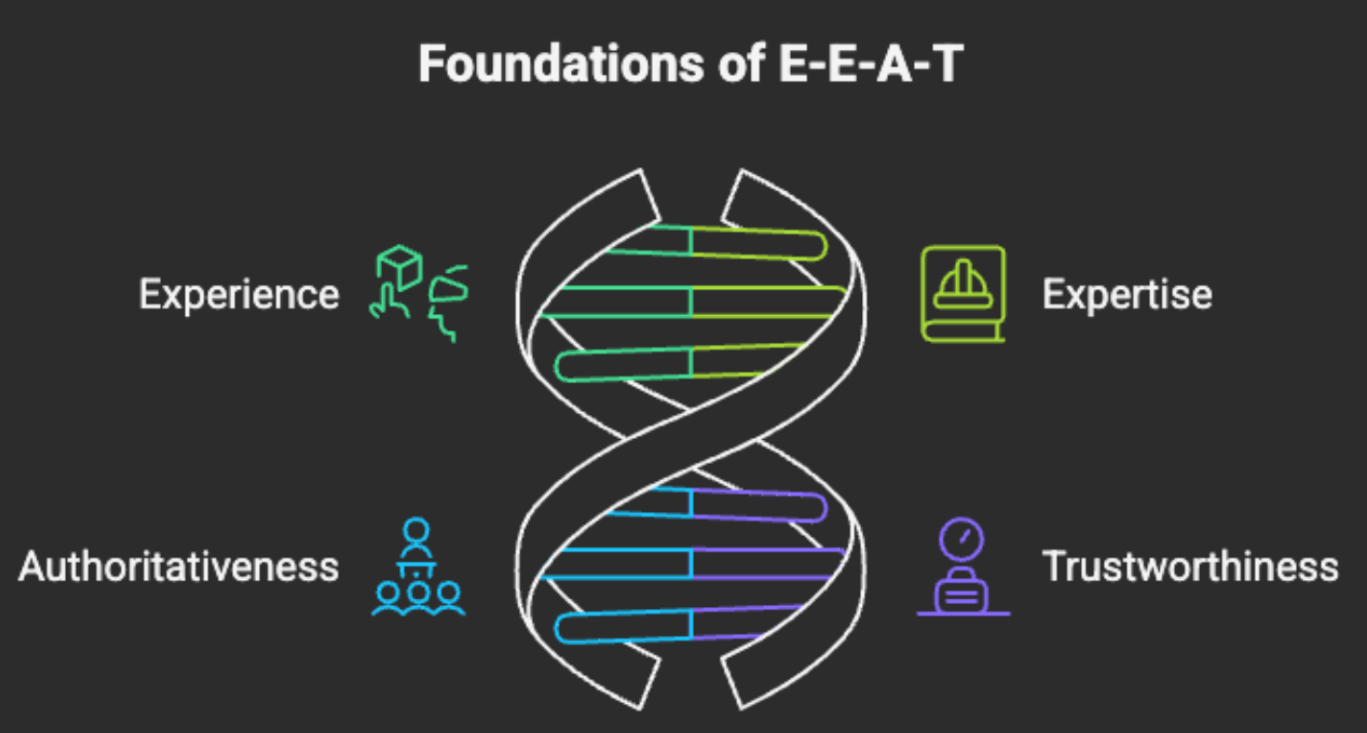
The four components of E-E-A-T
Experience — The extent to which the content creator has first-hand or real-world experience with the topic. Whether they have actually used the product, visited the place, or worked directly in the field being discussed.
Expertise — The level of knowledge or skill the content creator possesses, developed through education, professional training, or consistent practical work.
Authoritativeness — How well recognised the content creator or website is as a reliable source on the subject. Built primarily through external signals: citations, mentions, references, and high-quality backlinks.
Trustworthiness — Whether the page and website are accurate, transparent, safe, and honest. The most critical component — Google identifies trust as the foundation of E-E-A-T.
Why E-E-A-T matters for SEO
E-E-A-T matters because it shapes how Google evaluates page quality at scale. The Quality Evaluator Guidelines are used by thousands of human raters worldwide. Google's guidelines document references E-E-A-T 116 times, and those assessments inform how ranking systems are refined.
Content that consistently demonstrates E-E-A-T principles is more likely to withstand algorithm updates and build long-term search performance.
Pages with strong E-E-A-T signals have a 30% higher chance of ranking in the top 3 positions vs weak signals.
How Google actually infers E-E-A-T signals
Most guides explain what E-E-A-T is. Few explain how Google actually reads it algorithmically. Here's what the signals map to in practice:
E-E-A-T Dimension | How Google Infers It |
Experience | Original photos, first-person detail, timestamps, case studies |
Expertise | Author pages, credentials, depth of content, and accurate sourcing |
Authoritativeness | Backlinks, brand mentions, citations in third-party content |
Trustworthiness | HTTPS, About/Contact pages, review signals, and UX quality |
Google does not rely solely on on-page claims and instead cross-references external signals such as links, mentions, author entities, and review signals to evaluate credibility.
How E-E-A-T signals build over time
Strong E-E-A-T is rarely built from one thing — it's the result of multiple reinforcing signals working together.
Content Signals
Depth and accuracy of information
First-hand experience is demonstrated in the content
Original data, screenshots, and case studies
Identity Signals
Clear author identity established on the site
Brand recognition across the web
Consistent topical coverage over time
External Validation Signals
Editorial backlinks from relevant, credible sites
Brand mentions and citations in third-party content
Guest contributions, expert quotes, and media appearances
Trust Signals
HTTPS security and clean UX
Transparent About, Contact, and Privacy Policy pages
Real business information and genuine review signals
Most sites focus only on content quality. The strongest sites build all four areas consistently — and that's exactly what separates a page that ranks from one that sticks.
Experience: Demonstrating first-hand knowledge
Experience is the newest addition to the framework. It recognises that content quality can be evaluated through the lens of the creator's direct involvement with a topic not just formal credentials or research.
Experience and expertise are distinct. Expertise comes from education, training, and mastery of a subject. Experience comes from direct participation and real-world involvement. A cancer survivor has genuine experience discussing the disease, even without a medical degree. A chef with 15 years in fine-dining kitchens has experience that a food science PhD may not. Google values both but they are different things.
How to signal experience:
Use first-person language that demonstrates direct involvement: "When we tested this product over 3 months"
Include original photos, screenshots, or videos showing you've actually done what you describe
Share specific details and outcomes that only someone with direct involvement could know
Publish case studies, before/after comparisons, and real-world data from your own work
Add timestamps and document updates to show ongoing engagement with the topic over time
Expertise: Showing real knowledge and skill
Expertise is demonstrated through depth, accuracy, and clarity — not through buzzwords or keyword density. Content should explain concepts in a way that reflects genuine understanding, uses correct terminology, and avoids oversimplification where precision matters.
Author-level expertise signals:
Clearly state who wrote the content with a detailed bio covering credentials, qualifications, and relevant experience
Link author bios to a full author page showing a body of work and topic specialisations
For YMYL topics (health, finance, legal, safety), have content written or reviewed by a credentialed professional and clearly disclose this
Back up claims with primary sources, studies, and data. Explain the reasoning, not just the conclusions
Keep content updated as the field evolves — outdated information signals declining expertise
Site-level expertise signals:
Build clear topical depth through pillar pages and supporting cluster content
Internal linking that connects related content reinforces genuine breadth across a topic
A published editorial process showing how content is researched, reviewed, and updated signals systematic quality
Authoritativeness: Building credible standing over time
Authoritativeness is about external recognition. Unlike experience and expertise which are largely about what you do and know authority is largely what others say about you.
This builds over time through consistent, high-quality output. Publishing accurate, in-depth content on a topic repeatedly helps establish topical authority. When multiple pages reinforce each other within a topic cluster, the site becomes easier for search engines to trust in that domain.
How to build authoritativeness:
Earn backlinks from reputable, relevant sites — editorial links from industry publications and news mentions carry far more weight than directory or reciprocal links
Get cited and mentioned in roundups, studies, and expert guides as a reference source
Contribute guest articles, podcast appearances, speaking engagements, or expert quotes to publications in your field
Display awards, press coverage, and third-party recognition clearly on the site
Use Schema markup (Organisation, Person, Article schema) to make your authorship and site identity machine-readable
Build author entity profiles that connect your content to a consistent, verifiable identity across the web — this helps AI systems recognise and cite your content
Trustworthiness: Making content safe and reliable
Trustworthiness is the foundation of E-E-A-T. A sophisticated financial fraud operation run by an experienced scammer may have experience and perceived expertise — but it is not trustworthy. Trust is the non-negotiable bedrock.
Content-level trust signals:
Ensure all factual claims are accurate and sourced. Link to primary sources and explain limitations where relevant
Update content when data changes or guidance evolves
Correct errors transparently with a visible correction notice rather than silent edits
Avoid misleading headlines, clickbait, or content that makes exaggerated claims
Site-level trust signals:
Use HTTPS — a non-HTTPS site is flagged as insecure by browsers and is a basic trust failure
Publish clear About, Contact, Privacy Policy, and Terms of Service pages
Display a real address, phone number, and identifiable team for businesses, especially in YMYL niches
Enable and prominently feature genuine user reviews
Avoid intrusive ads, auto-playing media, or pop-ups that obstruct content
52% of AI Overview sources come from the top 10 search results. Strong E-E-A-T trust signals directly determine whether your content is cited in AI-generated answers.
E-E-A-T for YMYL and non-YMYL content
E-E-A-T applies to all content, but the standards vary by topic and the potential consequences of inaccurate information.
YMYL Topics
YMYL (Your Money or Your Life) covers content that can directly affect a person's health, financial well-being, legal standing, safety, or major life decisions. Google's guidelines indicate YMYL pages are evaluated under higher E-E-A-T expectations. As of the September 2025 Quality Rater Guidelines update, the YMYL scope was further expanded to include content related to elections, public institutions, and civic trust.
Medical content: Must be written or reviewed by credentialed medical professionals. Author credentials should be clearly displayed, sources cited, and content updated regularly.
Financial content: Should involve qualified financial professionals. Transparent disclosures about conflicts of interest are expected.
Legal content: Must clearly identify qualified legal professionals involved, include jurisdictional caveats, and avoid presenting general guidance as specific legal advice.
News and civic content: Should demonstrate editorial independence, transparent sourcing, and verifiable institutional accountability.
Non-YMYL Topics
For non-YMYL topics, formal credentials matter less — but accuracy, clarity, and honest sourcing still matter. Practical experience, clear explanations, and transparent authorship are often sufficient. Even non-YMYL pages can harm trust and rankings if they include misleading advice, unsupported claims, or hidden intent.
E-E-A-T and AI-generated content
The rise of AI-generated content has made E-E-A-T signals more critical, not less. The December 2025 Core Update was widely interpreted as targeting low-quality scaled AI content. Early industry testing showed that many sites relying heavily on unreviewed AI content experienced ranking declines.
The practical implication: AI-written content must be reviewed, edited, and enriched by genuine subject-matter experts before publication. The content should demonstrate specific, firsthand knowledge that an AI working from general training data cannot produce on its own.
AI can draft. Humans must validate, enrich, and take ownership.
How E-E-A-T fits into your content strategy
E-E-A-T works best when integrated into your broader content architecture:
Pillar pages should feature your most credentialed author on the topic, carry the most comprehensive sourcing, and be maintained most rigorously
Cluster pages reinforce topical authority. Each one adds depth and demonstrates expertise in a sub-area
Internal linking from authoritative pages to newer or more specific content distributes trust signals across the site
Editorial governance ties everything together, a documented process for topic selection, author assignment, expert review, fact-checking, and regular updates ensures E-E-A-T is systematic, not accidental
For content teams, E-E-A-T should be part of the brief not an afterthought. The author assigned, the sources required, the review process, and the update schedule should all reflect the E-E-A-T standards appropriate for the topic.
Conclusion
E-E-A-T is not a checklist or a quick SEO tactic. It is a framework for building content that deserves visibility.
The addition of Experience in December 2022 was not a minor tweak — it was Google signalling a fundamental shift toward valuing the human, lived, verifiable credentials behind content over generic, keyword-optimised text that anyone (or any AI) could produce.
By demonstrating real experience through firsthand accounts and original documentation, real expertise through qualified authorship and sourced claims, authoritativeness through recognition and citation from credible peers, and trustworthiness through accuracy, transparency, and site integrity — you align your content with what Google's systems are specifically trained to reward.
When E-E-A-T is embedded into your content creation process, pillar strategy, and editorial governance, SEO becomes more resilient. Rankings improve not because of tricks — but because the content genuinely serves users and earns credibility over time.