Ahrefs and Semrush are two of the most widely used SEO tools in the industry. Both are used by SEO professionals, agencies, and marketing teams to research keywords, analyze competitors, track rankings, and audit websites.
Although both tools cover similar core SEO functions, they are built with different priorities. Ahrefs is primarily focused on SEO data and research, while Semrush offers a broader toolkit that includes SEO along with content and competitive insights.
In this guide, we compare Ahrefs and Semrush based on their features, data, and practical usage to help you understand how they differ and where each tool performs better.
Comparing Ahrefs and Semrush as per key SEO use cases
At a high level, Ahrefs and Semrush overlap across most core SEO capabilities. Both tools support keyword research, backlink analysis, rank tracking, technical audits, and content optimization. However, the way these features are implemented, prioritized, and limited differs significantly.
The table below highlights feature availability at a surface level. The sections that follow explain how these features differ in practice and where those differences matter.
Key Feature Comparison at a Glance
Feature | Ahrefs | Semrush |
Keyword research | Available | Available |
Search intent labels | Available | Available |
Backlink analysis | Available | Available |
Technical SEO audit | Available | Available |
Rank tracking (daily) | Limited by plan | Available |
Mobile vs desktop tracking | Available | Available |
Location-based tracking | Available | Available |
Content writing assistant | Available | Available |
Credit-based pricing | Yes | No |
Fixed monthly limits | No | Yes |
1. Keyword Research
Keyword research involves identifying the words and phrases people search for on Google before visiting a website.
Both Ahrefs and Semrush maintain very large keyword databases, with Ahrefs reporting coverage of 28+ billion keywords across 200+ countries , and Semrush reporting 26+ billion keywords with strong global market coverage . Each tool provides essential metrics such as search volume, keyword difficulty, competitive context, estimated traffic potential, and search intent labels.
Ahrefs displays keyword ideas mainly as detailed keyword lists, showing metrics such as keyword difficulty, monthly search volume, and estimated clicks, which helps evaluate how much actual traffic a keyword may generate.
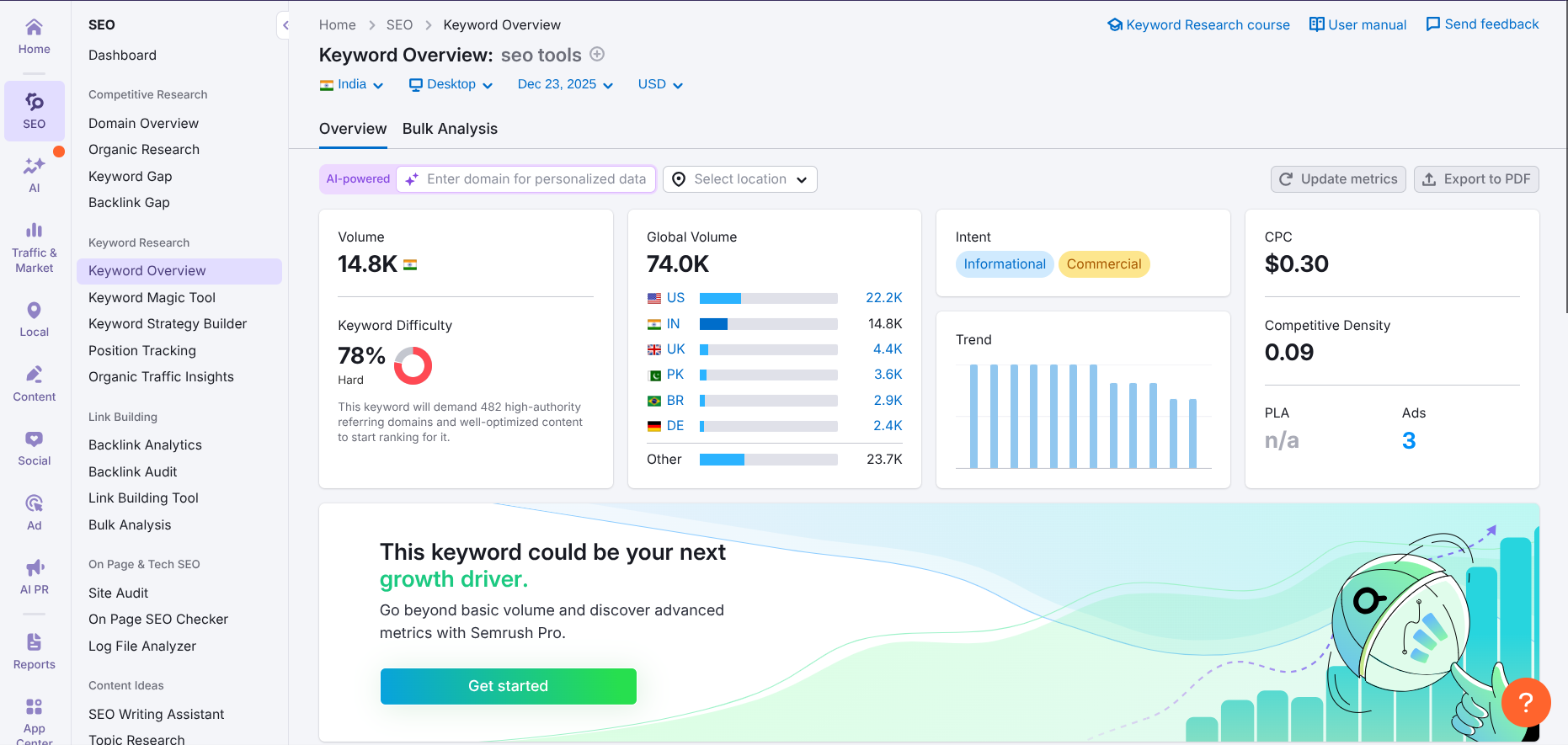
Semrush also offers extensive keyword variations but organizes them into structured groups and clusters inside its keyword research tools, placing stronger emphasis on usability within content planning and broader marketing workflows.
The main difference lies in how keyword difficulty (KD) is calculated and used. Ahrefs calculates keyword difficulty primarily based on the number and strength of referring domains pointing to the top-ranking pages, while Semrush calculates keyword difficulty using a broader mix of SERP competition signals beyond backlinks.
Because of these differences, the KD metrics in Ahrefs and Semrush should not be treated as identical. Each tool answers a slightly different question about how competitive a keyword is.
Overall, both tools are strong for keyword research, but they approach difficulty measurement and keyword organization differently, which can influence how SEO effort and content strategy are planned.
2. Backlink Analysis
Backlinks are links from other websites pointing to your site, and they remain an important ranking factor.
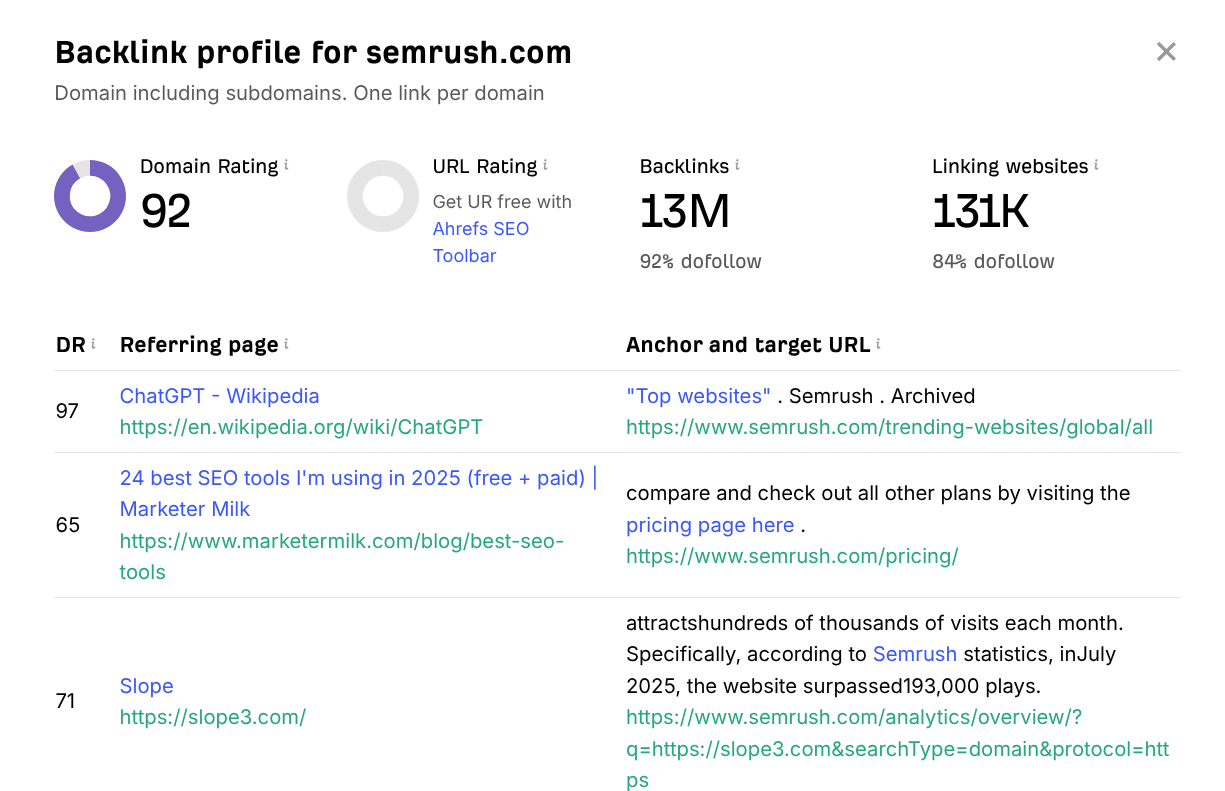
Ahrefs is widely used for backlink research and competitor analysis and maintains one of the largest backlink indexes in the industry, reporting the ability to crawl 8+ billion pages per day and track trillions of known backlinks. It provides detailed backlink data that helps identify linking domains, backlink growth trends, and competitor link patterns.
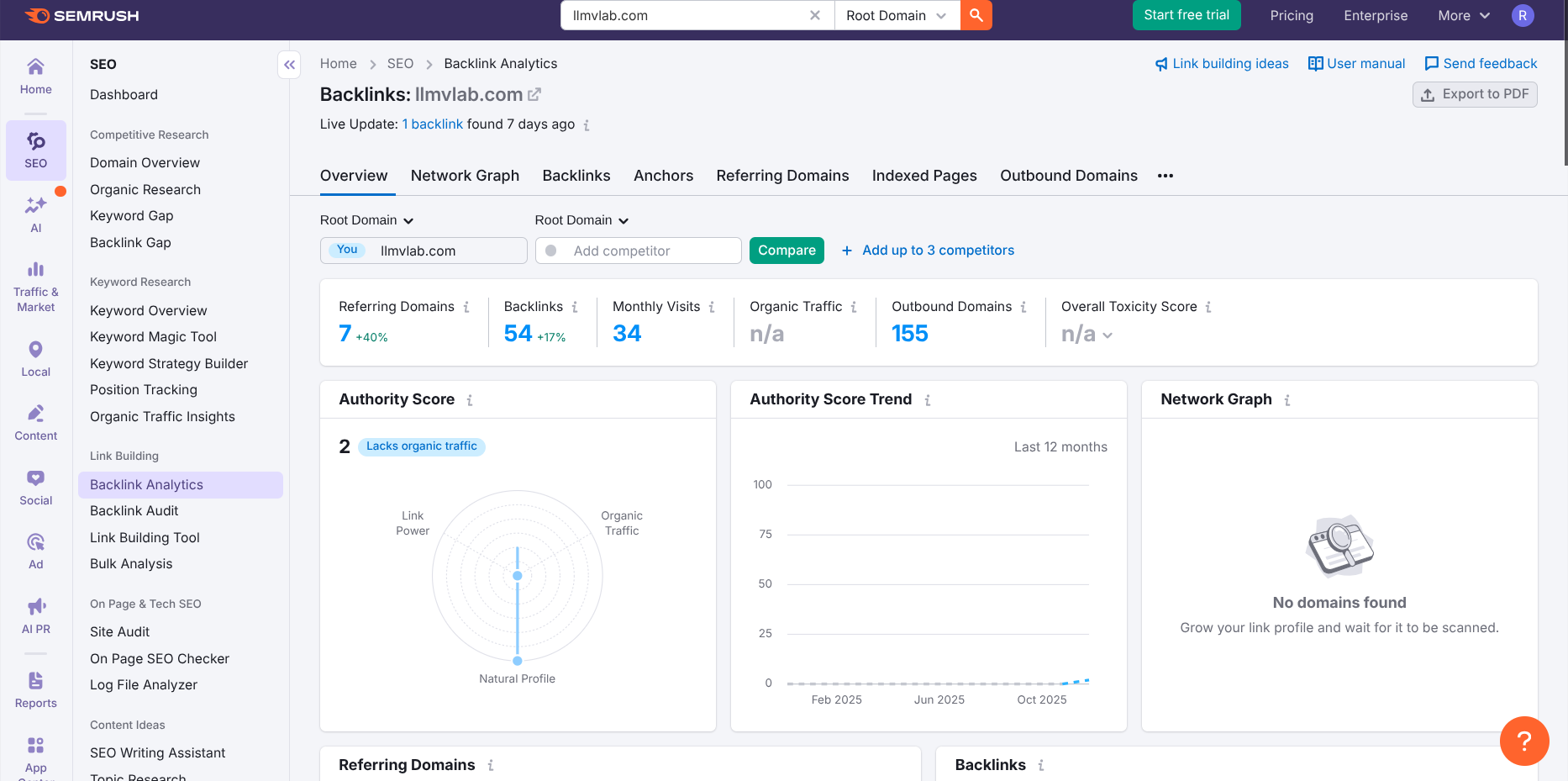
Semrush also provides backlink analysis and competitor comparison, with its backlink database reporting coverage of 40+ trillion backlinks. In addition to backlink discovery, Semrush places more emphasis on backlink monitoring and link quality, including features that help identify potentially harmful links and track changes in backlink profiles over time.
Both Ahrefs and Semrush allow users to analyze referring domains, anchor text distribution, new and lost links, and competitor backlink gaps. While Ahrefs focuses more on backlink exploration and competitive link discovery, Semrush includes additional backlink audit and link quality evaluation tools as part of its broader SEO workflow.
3. Rank Tracking
Ahrefs supports rank tracking with weekly updates on lower plans and daily updates on higher plans. It shows keyword position changes over time through a clean and simple interface.
Semrush provides daily rank tracking across plans and presents ranking data in a more detailed and flexible dashboard.
Both tools support rank tracking for mobile and desktop and allow tracking based on location. The main difference lies in how frequently rankings are updated and how the data is managed within each platform, rather than in the availability of these features.
Overall, both Ahrefs and Semrush handle rank tracking well, and the choice depends more on update frequency and reporting preference than on core tracking capabilities.
Rank tracking takeaway: Semrush favors continuous operational tracking, while Ahrefs prioritizes simplicity and research-oriented views.
4. Technical SEO
Technical SEO focuses on issues that affect how search engines crawl, render, and understand a website, such as crawl errors, internal linking, site structure, JavaScript rendering, and performance.
Both Ahrefs and Semrush provide site audit tools that crawl websites, surface technical issues, and assign an overall site health score. These audits help identify problems that may affect crawlability, indexation, and user experience.
Site audit
Ahrefs' site audit is designed for speed and clarity. It highlights core technical issues with concise explanations and clear severity levels, making it easier to quickly understand what is broken without being overwhelmed by excessive alerts. This approach works well for experienced SEOs who want fast insights and clean prioritization.
Semrush's technical audit is more exhaustive. It often surfaces a larger number of issues, including minor and edge-case problems, and provides detailed explanations and suggested fixes. While this can be helpful for thorough audits and less technical users, it may also introduce noise, requiring additional judgment to separate critical issues from low-impact ones.
Log file analysis
Semrush offers log file analysis on higher plans, which helps assess real crawl behavior and crawl budget usage based on server data. Ahrefs does not include log file analysis and instead focuses on crawl-based audits.
Technical SEO takeaway: Ahrefs emphasizes speed and prioritization, while Semrush emphasizes coverage and instructional depth.
5. Content Writing Tools
Both Ahrefs and Semrush offer content-related tools designed to support SEO optimization, but they differ in how closely these tools are tied to writing workflows.
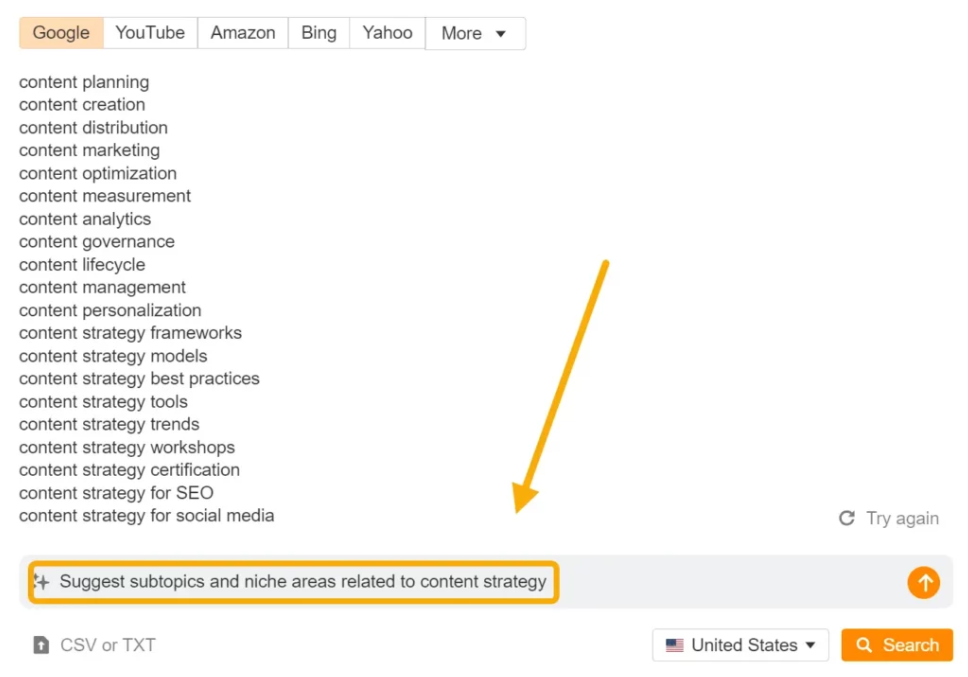
Ahrefs' content tools are SEO-first. They focus on keyword usage, search intent alignment, and SERP-based analysis to help evaluate whether content is likely to perform well in search.
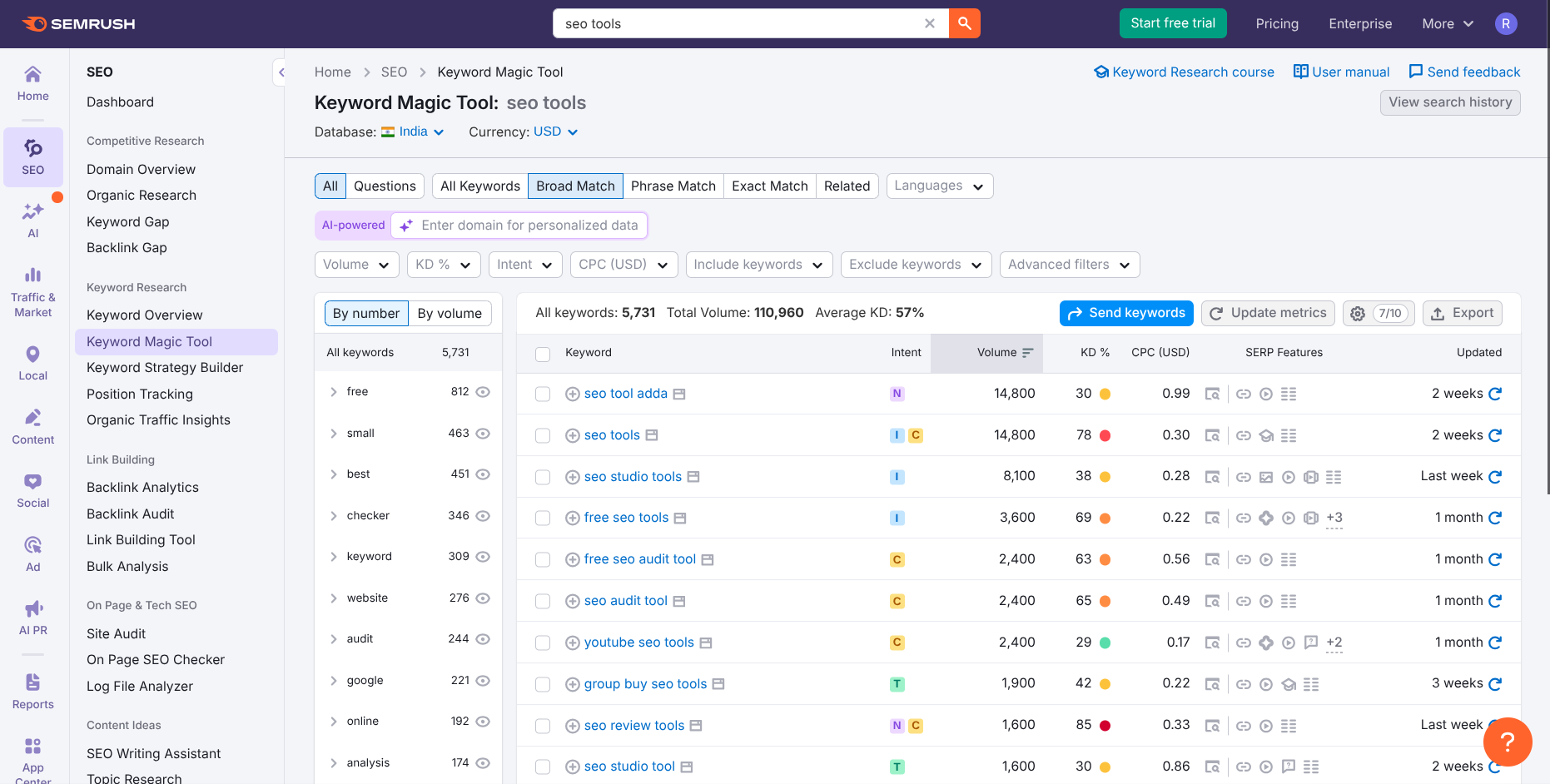
Semrush's content tools are more editorial-workflow-first. Its SEO Writing Assistant integrates directly with platforms like WordPress and Google Docs, allowing optimization checks to happen while content is being written.
Content tools takeaway: Ahrefs supports content planning decisions, while Semrush supports in-workflow content execution.
6. Pricing
Ahrefs and Semrush use different pricing approaches, which makes direct price comparisons misleading.
Ahrefs follows a credit-based usage model, where actions like crawling and data analysis consume monthly credits.
Semrush uses a fixed-limit model, with caps on projects, tracked keywords, and daily usage.
Pricing Plans (Comparable Usage Levels)
Plan Level | Ahrefs | Semrush | Intended Use |
Starter / Entry | $129 | $199 | Core SEO needs for small teams |
Mid-Tier | $249 | $299 | Full SEO workflows |
Advanced | $449 | $549 | Large sites and in-house teams |
Pricing may vary by region and is subject to change.
Which One Should You Choose?
The choice between Ahrefs and Semrush depends less on individual features and more on how SEO work is structured within your organisation.
Choose Ahrefs if:
Your SEO work is mainly research-driven
You spend significant time on backlink analysis and competitor research
You prefer working directly with raw SEO datasets and metrics
You are comfortable with a credit-based usage model
You need location-based SEO insights as part of competitive or market research
Choose Semrush if:
Your SEO work involves ongoing rank tracking and reporting
You collaborate closely with content and marketing teams
You need daily monitoring across multiple locations and devices
You prefer predictable feature limits over usage-based credits
You want built-in toxic link detection and backlink health monitoring as part of your workflow
What SEO managers are saying about Ahrefs vs Semrush
We use Semrush as our primary tool. Its site audit and position tracking scale well across thousands of SKU and category pages, and the intent/topic tools help us plan buyer-education content on freight class, NSF/ETL, hood types, make-up air, and remote condensers.
We still keep Ahrefs for backlinks. Its index and Link Intersect are stronger for earning manufacturer/distributor links and reclaiming unlinked brand mentions. If I had to pick one for ecommerce ops, it's Semrush for the mix of technical SEO, content planning, and reporting.
- Stephen Rahavy, President and Owner at Kitchenall
I use Ahrefs. After years of running campaigns where organic search directly impacts revenue, I’ve found Ahrefs to be the most reliable source for backlink data and competitive analysis.
Their crawler is consistently fast, the link index is deep, and when we’re auditing a site or planning content around search demand, the data feels cleaner and less inflated.
For an explainer video company like ours, which often targets high-intent B2B keywords, accuracy matters more than having a dozen extra features we don’t use daily.
That said, Semrush is a solid platform, especially for teams that want an all-in-one digital marketing suite.
But in practice, my team and I live in Ahrefs because it helps us answer the questions that actually move the needle: who’s ranking, why they’re ranking, and what it would realistically take to outrank them.
After 10+ years in digital marketing, I’ve learned that the best tool isn’t the most comprehensive one. It’s the one you trust enough to base real decisions on, and for us, that’s Ahrefs.
- Andre Oentoro, CEO of Breadnbeyond
I have been using the services of Semrush for the past three years, and I simply do not think I could switch over to another toolset no matter what it cost. I find the keyword magic tool interface to be simply seamless, not to mention the convenience of having so many services wrapped up into the one toolset – the SEO audit, pay per click campaigns, content marketing, social media monitoring services – it really does have it all covered, especially at this level of cost I am not sure what I was expecting from Ahrefs’ products, but I am pretty sure they have slightly more backlinks indexed, but it simply does not have the level of functionality I need in regards to tracking position or site audit solutions. The interface also simply feels more refined, with historical data sets stretching back farther than I need it to in my client reports, which is simply invaluable.
- Mohamed Abd Elkhalek, Digital Marketing Specialist at GLOBAL-ETHOS
After years of using both platforms for client work and managing the SEO for a content-driven platform, I consistently choose Ahrefs as my primary tool.
For the core SEO work of driving organic growth, like keyword research, backlink analysis, and competitor research, Ahrefs delivers a more focused and reliable experience. While Semrush offers a broader marketing suite, Ahrefs provides the deeper, more accurate data I need for strategic decisions without the clutter.
The main draw for me is the exceptional quality of Ahrefs' data and its straightforward interface. Tools like Site Explorer compile essential metrics into a single, clear dashboard, making it fast to audit a site's health or analyze a competitor's top pages.
This utilitarian design, which some users find more direct than flashier interfaces, allows me to get answers quickly and trust that the insights closely reflect reality.
- Isabella Rossi, CPO at Fruzo
I default to Ahrefs because I trust its backlink data more when real money’s on the line. When I’m auditing competitors or deciding whether a keyword is worth six months of effort, Ahrefs feels closer to reality and less optimistic. Semrush is powerful, but Ahrefs hurts my feelings more and that’s usually the truth.
The real Ahrefs vs Semrush debate isn’t tools, it’s mindset. Ahrefs is a scalpel that is great for links, competitive gaps, and cold analysis. Semrush is a Swiss Army knife. I reach for Ahrefs when decisions are irreversible, and Semrush when exploration still feels safe.
- Deepak Shukla, Founder & CEO of Pearl Lemon Leads
From hands-on experience, many SEO practitioners prefer Ahrefs for backlink analysis and research speed, its link index feels more intuitive, and finding competitor backlink opportunities is faster when you just want to start actioning. On the other hand, Semrush tends to be favored by teams who need a broader suite of features, site audits, keyword tracking, on-page reporting, PPC data, and competitive insights all in one place. I would personally choose Ahrefs when I need deep link data quickly, but then switch to Semrush when I require “everything from technical SEO to paid insights in one dashboard.”
The practical takeaway teams often mention is that Ahrefs feels sharper for pure SEO research, while Semrush feels more like a marketing OS. Preferences usually come down to whether your focus is backlinks and discovery (Ahrefs) or end-to-end campaign strategy (Semrush).
- Abhishek Shah, Founder of Testlify
I’ve used both Ahrefs and Semrush extensively for B2B SaaS and content-led growth work. My short take is: neither tool is “better” in isolation they’re optimized for different decision-making styles. Ahrefs is my default when the core job is SEO research and prioritization. Its backlink data, keyword difficulty signals, and content gap analysis feel tighter and less noisy. When I want to answer “should we build this page or not?” Ahrefs usually gets me there faster. Semrush shines when SEO isn’t operating alone. If you’re running paid search, competitor positioning, content calendars, or reporting for stakeholders, Semrush’s ecosystem is broader. It’s more of a marketing OS than a pure SEO tool. In practice, early-stage or SEO-first teams tend to get more clarity from Ahrefs. Growth-stage teams with multiple channels often benefit more from Semrush. I’ve seen the best results when teams choose based on how decisions are made, not feature checklists.
- Sonu Goswami, SaaS Content Writer, B2B Marketing expert in SonuSaaSWriter
We actively use both Ahrefs and Semrush, but I reach for each of them for very different reasons.
When we are doing deep backlink analysis, competitive gap work and link prospecting at scale, Ahrefs tends to be the tool of choice. Its backlink index has consistently felt fresher and more complete in real use, especially when we are dissecting aggressive competitors in tougher niches. The link intersect reports, anchor text breakdown and historical link graphs make it easier to reverse engineer what is actually driving authority rather than just looking at vanity metrics. For pure off-page SEO and technical link audits, Ahrefs usually wins inside our team.
On the other hand, when we are treating SEO as part of a wider growth and performance strategy, Semrush becomes more valuable. The way Semrush pulls together keyword data, position tracking, site audits, content templates, PPC data and basic social insights in one place is very helpful from an operator’s perspective. For example, when we are building a content and search strategy that must tie into Google Ads and overall funnel metrics, Semrush’s visibility reports and keyword intent segmentation give us a clearer “board level” view.
If I had to oversimplify our usage: Ahrefs is our scalpel for serious backlink and competitive organic research. Semrush is our Swiss army knife for ongoing site health, campaign planning and reporting to non-technical stakeholders. We subscribe to both, but if a client is very content and growth focused with lighter link-building needs, we lean Semrush. If they are in a highly competitive space where authority is everything, we lean Ahrefs.
- David Hunt, Chief Operating Officer at Versys Media
I primarily use Semrush because, in most real business environments, SEO doesn’t operate in isolation. In my work across growth, engineering, and finance, SEO is usually one input among many that influence revenue, attribution, and strategic decision-making. Semrush aligns well with this reality by bringing together competitive research, paid search data, content strategy, technical SEO, and reporting in a single system, which reduces friction for teams and makes insights easier to act on across departments.
That said, Ahrefs clearly outperforms in specific areas. Its backlink analysis, historical link data, and clean interface make it exceptionally strong for deep SEO work, particularly when diagnosing ranking drops, analyzing link velocity, or auditing referring domain quality. I’ve often seen teams use Ahrefs as a specialist tool when the goal is forensic analysis rather than broad growth planning.
The biggest mistake I see is treating the Ahrefs vs Semrush decision as a popularity contest instead of a workflow decision. The right choice depends on how decisions are made inside an organization. If SEO is part of a broader, revenue-driven system with multiple channels involved, Semrush is often the better fit. If SEO itself is the core product or focus, Ahrefs may feel more intuitive and precise.
- Dennis Shirshikov, Combined leadership + academic role in Growthlimit
Conclusion
Ahrefs and Semrush are both strong SEO tools, but they are optimized for different ways of working with SEO.
Ahrefs is best suited for teams that treat SEO as a research-focused discipline, where data depth, backlink exploration, competitive analysis, and location-based insights guide strategic decisions.
Semrush is better suited for teams that treat SEO as an execution-oriented system, combining rank tracking, content optimization, multi-location monitoring, and backlink health checks (including toxic link detection) into a single, structured workflow.
Rather than asking which tool is better, the more useful question is whether SEO in your organization is primarily research-driven or execution-driven. Once that is clear, the right choice usually becomes straightforward.