Link building is the practice of earning inbound links from other websites to your own. Each link functions as an editorial signal, a declaration that another site found your content credible and useful enough to reference. Search engines treat these signals as one of their most reliable indicators of authority, relevance, and trust.
This guide covers everything you need to build a sustainable, high-impact link-building strategy: what links are, why they matter, what makes a backlink genuinely high quality, and how to earn those links through ethical, proven methods. Measurement, backlink auditing, and common mistakes are addressed in the final sections.
Why link building still dominates SEO
Google's original PageRank was built on a deceptively simple insight: if many credible sites link to a page, that page is probably valuable. Decades of algorithm evolution haven't displaced that logic — they've refined it.
Statistic | Insight |
Pages ranking #1 have significantly more backlinks than positions #2–10 | |
Most indexed pages have zero backlinks | |
Most blog posts receive no external links |
That last number puts things in perspective. You're not competing against every page on the internet — you're competing against the small fraction that has earned any links at all. That gap is where real opportunity sits.
There's also a competitive dimension worth acknowledging honestly. Building a clean, editorially earned link profile is hard and slow. That's precisely why it creates a durable advantage. Shortcuts are easy to replicate; genuine editorial trust is not.
What links actually signal in 2026
Modern search engines don't just count links; they interpret them. A backlink today contributes to several layers of how your site is understood.
Topical Authority
Links from sites in your niche place you inside a topic ecosystem. When credible sites consistently reference you on a subject, search engines start treating you as a recognised voice in that space, not just a page, but an entity associated with a specific area of knowledge.
Editorial Trust
An editorial link signals a human judgment: this is worth referencing. That's a fundamentally different signal from a directory entry or a paid placement. Search engines have become exceptionally good at distinguishing between them.
Discoverability & Referral Traffic
Links remain one of the primary mechanisms by which crawlers find new content. For sites with genuine editorial links from relevant sources, referral traffic quality tends to be high — these visitors arrive with context and intent.
Visibility in AI Search
Early industry testing suggests AI search systems tend to cite pages that already rank well or demonstrate strong authority signals such as backlinks and brand mentions. While AI ranking factors remain undisclosed, this suggests backlinks may not be a direct requirement but likely remain an indirect authority signal through their influence on traditional rankings.
The shift that changes everything: The old question was "How do I get links?" The better question is "Why would anyone cite this instead?" That shift moves the strategy from link acquisition toward building genuinely cite-worthy content.
What makes a backlink actually valuable
Not all links are equal. One strong editorial link from a relevant, trusted publication can outperform fifty generic directory entries. Here's what actually separates a valuable link from a forgettable one.
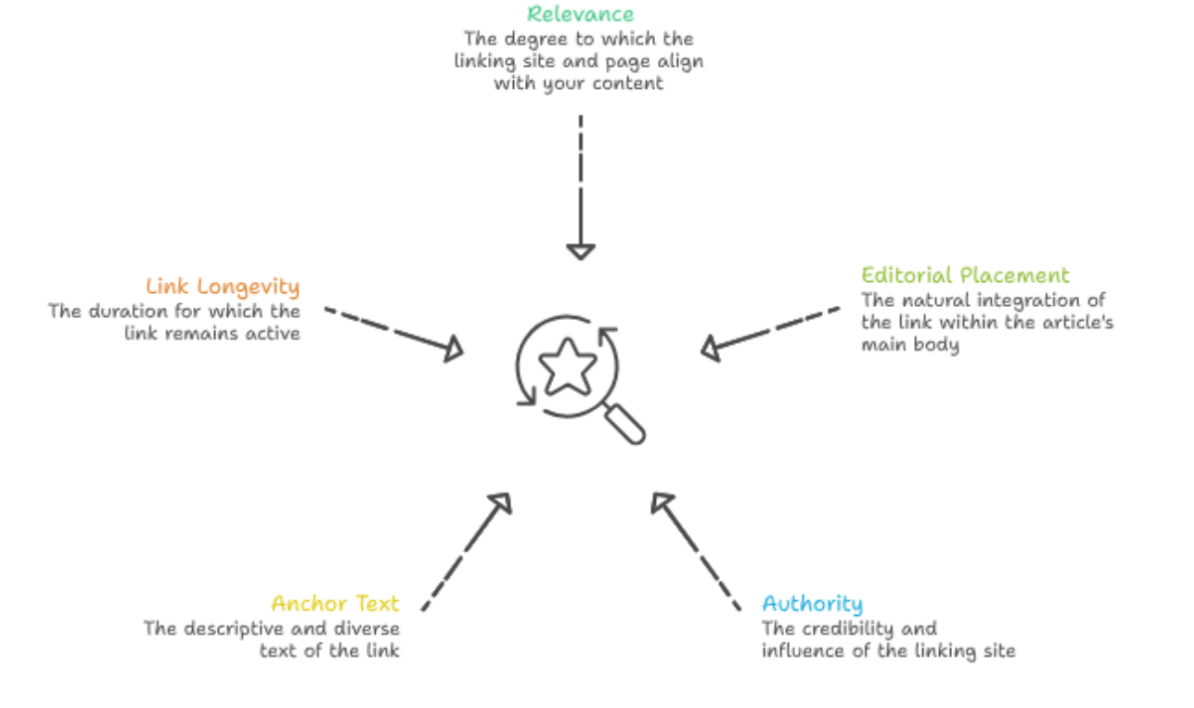
1. Relevance - The Non-Negotiable
According to an Authority Hacker survey of SEO professionals, 84.6% rank relevance as the single most important quality signal above domain authority, traffic, or any other metric. Relevance works at two levels: domain relevance (whether the linking site broadly covers your topics) and page relevance (whether the specific article linking to you is closely related to your page). Page-level relevance carries more weight.
2. Editorial Placement
Where a link sits on a page matters significantly. An editorial link is embedded naturally in the main body of an article because the author judged it genuinely useful. A manufactured link sits in a footer, sidebar, or bulk directory because someone put it there for SEO purposes. Search engines have developed strong pattern recognition for this distinction.
3. Authority - But Not Just a Number
Tools like Ahrefs Domain Rating, Moz Domain Authority, and Semrush Authority Score are useful directional signals, not ranking factors, and not substitutes for judgment. A smaller, highly relevant site in your exact niche will often pass more genuine authority than a high-DR generalist site with no topical connection to your content.
4. Anchor Text - Diversity Is a Trust Signal
Anchor text is the visible, clickable text of a link, for example, "a guide to mortgage refinancing" linking to a mortgage guide. Natural, descriptive anchor text communicates relevance without appearing manipulative. A healthy link profile includes a mix of branded anchors, descriptive phrase anchors, partial matches, and some generic anchors. Diversity is itself a trust signal.
5. Link Longevity
A link that disappears within months provides little lasting value and often indicates low editorial commitment. When evaluating a prospect, consider how long the site has been publishing, whether existing content has aged well, and whether they actively maintain their archive.
The CLARITY framework
Before pursuing any link opportunity, run it through these seven questions. If it fails more than two, it's probably not worth the effort.
C | Contextual Relevance | Is the linking page actually about your topic — not just the site in general? |
L | Link Placement | Is it inside the main editorial content, not a footer, sidebar, or directory? |
A | Authority Pattern | Does the site show real editorial standards — consistent publishing, credible authorship? |
R | Referral Potential | Could this link actually send relevant visitors, or is it purely an SEO play? |
I | Indexation & Activity | Is the page indexed, crawlable, and actively maintained? |
T | Text Naturalness | Does the anchor text feel organic, or does it look keyword-stuffed? |
Y | Yield Over Time | Is this link likely to still exist in 12 months? |
Building a strategy that actually scales
Most link-building campaigns fail before outreach even starts — no clear goal, no baseline understanding of the existing profile, and no alignment between the content being promoted and the links being pursued.
Define Measurable Goals First
Link building without goals is an activity without direction. Common objectives include: increasing referring domains to specific pillar pages, improving rankings for a defined keyword set, building topical authority within a subject cluster, or growing branded visibility. Each maps to trackable metrics.
Audit What You Already Have
Before pursuing new links, understand your baseline. Which pages are already earning links and why? Which cornerstone pages have strong content but no referring domains? Are there any links in your current profile that look risky?
Study What Earns Links in Your Space
Competitor link analysis isn't about copying — it's about finding proven demand signals. If a competitor's guide has earned links from 40 relevant sites, those 40 sites have already demonstrated a willingness to link to content on that topic. They're qualified outreach targets.
Align Content With Link Intent
The most efficient link strategy is built around content that genuinely deserves links — particularly pillar pages that serve as comprehensive references on your core topics. Links earned by pillar pages flow authority through internal links to supporting cluster content, creating a compounding effect over time.
Set Realistic Timelines
A survey of 518 SEO experts found that agencies allocate 32–36% of their overall SEO budget to link building, and that noticeable results take an average of 3.1 months to materialise. Programs running continuously over 12 to 24 months consistently outperform sprint-based approaches.
How to earn high-quality backlinks
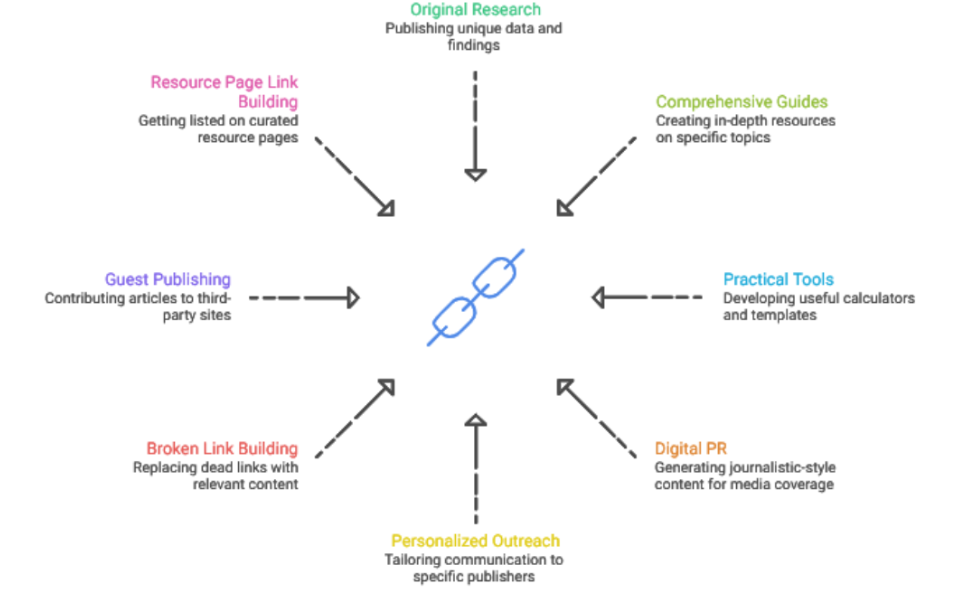
Every effective tactic comes back to the same foundation: having something worth linking to. Outreach succeeds in proportion to the quality of what you're asking people to reference.
Original Research & Data
Original data is the strongest link magnet available. When you publish research that doesn't exist anywhere else, you become a primary source. Every writer who covers your topic and needs a statistic must link back to you. A well-executed study can earn hundreds of links from credible publishers over its lifetime.
Comprehensive Guides
Long-form guides work because they become the definitive reference on a topic. When other writers cover that subject, they link to the guide rather than recreating it. The key is genuine comprehensiveness covering angles, nuances, and practical applications that shorter treatments skip.
Tools, Calculators & Templates
Practical resources earn persistent links because they remain useful long after publication. A well-built calculator or template gets bookmarked, shared, and referenced repeatedly. Utility creates repeat links in a way that even strong written content rarely achieves.
Digital PR
Digital PR earns links by creating content that functions like journalism — original findings, compelling data, or expert commentary that editors genuinely want to cover. According to DemandSage research, 48.6% of SEO professionals consider digital PR the most effective link-building tactic available. These links come from high-authority domains and carry significant brand visibility alongside their SEO value.
Personalised Outreach
The process that works: identify publishers who've already linked to similar content, read the pecific article you're referencing, note a gap your resource addresses, and write a short, specific email that leads with value rather than a request. Follow up once after five to seven days.
Broken Link Building
Find links on relevant websites that now point to dead pages, then reach out to suggest your content as a replacement. This works because you're helping the site owner fix a problem rather than asking a favour.
Guest Publishing
Contributing original articles to relevant third-party sites remains viable when done with genuine editorial intent. A simple test: would you be proud to have your name on that article, on that site? If the answer is no, the link isn't worth pursuing.
Resource Page Link Building
Many sites maintain curated resource pages listing the best tools and guides on a topic. Getting listed is efficient because the page's editorial intent is explicitly to recommend resources.
What most link-building advice gets wrong
✗ Myth: Domain Authority = link value DA/DR scores are directional indicators — not ranking factors. A lower-metric site in your exact niche can pass more genuine authority than a high-metric generalist site. |
✗ Myth: More links = better rankings Quality dominates volume. One editorial link from a relevant, trusted source consistently outperforms dozens of links from unrelated or low-quality sites. |
✗ Myth: Outreach is the hard part Weak content is the real bottleneck. If your strategy depends on convincing people to link to something mediocre, it was broken before outreach started. |
✗ Myth: Paid links scale safely They scale risk. Paid links without rel=sponsored attribution violate Google's guidelines, and algorithmic systems have gotten much better at detecting them. |
Link-building tactics Google is penalising right now
These approaches are still widely marketed, often by vendors who will have moved on by the time a penalty arrives.
Paid links without disclosure. Paying for links without rel="sponsored" attribution violates Google's guidelines. The sponsored attribute preserves referral traffic value while staying within the rules.
Private blog networks (PBNs). Clusters of sites created specifically to pass links are directly targeted by Google's spam guidelines. They may produce short-term lifts, but they're among the most reliable ways to trigger a manual penalty.
Reciprocal link schemes at scale. A natural number of mutual links between relevant partners is fine. Systematic, large-scale link exchanges signal manipulation clearly and are easy to detect.
Bulk low-quality campaigns. Purchasing large volumes of links from a single vendor, submitting to hundreds of directories, or participating in link networks rarely produces meaningful ranking improvements and frequently triggers algorithmic devaluation.
Maintaining and auditing your link profile
Earning links is only part of the work. Link profiles are not static sites that are linked to you; they may change their content, ownership, or quality standards. New low-quality links can appear without your initiation, and competitors sometimes build spammy links to rival sites to trigger penalties (negative SEO).
For most sites, quarterly audits are sufficient: review new referring domains since the last audit, check for unusual anchor text concentrations, and look for links from sites in clearly unrelated or low-quality niches. Sites in highly competitive verticals should be reviewed monthly.
When you identify genuinely harmful links, attempt removal first by contacting the site owner directly. If removal fails and the links pose a clear risk, use Google's Disavow Tool through Search Console. Don't over-disavow removing links you're uncertain about, as it can harm your profile by stripping legitimate authority signals.
Measuring what actually matters
Vanity metrics don't tell the full story. A growing referring domain count is useful, but only if those domains are relevant, editorial, and driving downstream SEO outcomes. Track both sides of the equation.
LINK QUALITY METRICS → Referring to domain growth over time → Proportion from industry-relevant sites → Anchor text diversity and distribution → Editorial vs. directory placement ratio → Dofollow/nofollow split (target ~60–70% dofollow) | SEO OUTCOME METRICS → Keyword position movement on target pages → Organic click-through rate on linked pages → Referral traffic volume and engagement → Rankings across the full query cluster → Citation frequency including AI surfaces |
Attribution isn't immediate. A link acquired this month may not produce measurable ranking changes for six to ten weeks. Measure trends over three-month periods rather than week-over-week.
One metric that matters more in 2026: Are you being cited more often — not just ranked? As AI search surfaces expand, citation frequency across the web is becoming a leading indicator of whether your authority is genuinely growing.
Link building in the age of AI search
The emergence of AI-generated search summaries — Google AI Overviews, Perplexity, ChatGPT search has raised genuine questions about whether traditional link building remains relevant. Early industry analyses suggest traditional authority signals like backlinks still correlate with AI citation visibility.
AI search systems appear to prioritise sources that demonstrate strong authority and trust signals. Early observations suggest sites with stronger authority signals, such as backlinks and brand visibility, may have a higher likelihood of being referenced.
Building links for authority and credibility isn't a legacy SEO tactic — it's increasingly relevant for visibility across every surface where search happens. The future of SEO is not just ranking. It's being referenced.
Build something worth referencing
The best link-building strategy doesn't look like link building. It looks like publishing original insights, maintaining content that stays current, and becoming a reliable source in your space.
Every link earned is a compounding asset. It contributes to your authority today and continues working for years. The goal isn't to collect as many links as possible — it's to build a profile that a knowledgeable human reviewer would recognise as the natural result of a credible, useful, well-regarded site.
Conclusion
Link building is not about collecting as many links as possible. It is about earning trust from credible sources in your space. As search evolves toward AI answers and authority signals, the value of genuine editorial links is only increasing.
The most sustainable strategy remains simple: create content worth referencing, build topical authority, and focus on long-term credibility instead of shortcuts. When your site becomes a reliable source, links stop being something you chase and start becoming something you earn.