Meta descriptions are one of those SEO elements that everyone tells you to write, but almost nobody explains properly. You will find contradictory advice all over the internet. Some say they are critical for SEO. Others say Google rewrites them anyway, so why bother? The truth, as usual, sits somewhere in the middle.
This guide explains exactly what a meta description is, how Google actually uses it, whether it affects your rankings, how to write one that earns clicks, and when it makes sense to let Google handle it for you.
What is a meta description
A meta description is an HTML element placed inside the head section of a webpage. It provides a short summary of what the page is about and typically appears as the grey or black text directly below the title tag in Google search results.
Here is what it looks like in code:
html
<head>
<meta name="description" content=" Learn what meta descriptions are, how to write them, and why they still matter for SEO and click-through rates in 2026." />
</head>

When someone searches on Google, they see three things for each result: the title tag, the URL, and the meta description. The meta description is essentially your pitch to the reader before they decide whether to click your link or scroll past it.
You may also hear the term "meta snippet" used interchangeably. A snippet is what actually appears in the search results, while the meta description is the tag you write in your HTML. The two are often the same, but not always, and that distinction matters, which we will cover shortly.
How Google actually uses meta descriptions
This is where most guides get things wrong, so it is worth understanding clearly.
When you write a meta description, you are not guaranteeing that Google will use it. Google reads your tag and then decides whether to display it as-is, rewrite it entirely, or pull a different piece of text from your page that it thinks better matches the user's search query.
According to Search Engine Journal, Google ignores or rewrites meta descriptions over 70% of the time for pages appearing on the first page of results. A more recent analysis by Straight North puts the figure at 60 to 70%. Either way, the majority of your written descriptions are being replaced.
The reason Google does this is actually logical. If someone searches "how to fix a broken title tag" and your meta description talks generally about on-page SEO, Google will pull the specific paragraph from your article that mentions title tag fixes instead. It is trying to show the most relevant answer to that specific query, not a generic summary of your page.
This means the same page can display different snippets in Google depending on the search query. A single article could have five different snippets appear across five different searches, each pulling from the section of your content that best matches the intent.
Do meta descriptions impact rankings
No. Meta descriptions are not a direct ranking factor. Google's Search Advocate John Mueller confirmed this explicitly, stating that the meta description is used as a snippet in the search results and is not something Google uses for ranking.
This has been Google's official position since at least 2009 and has not changed.
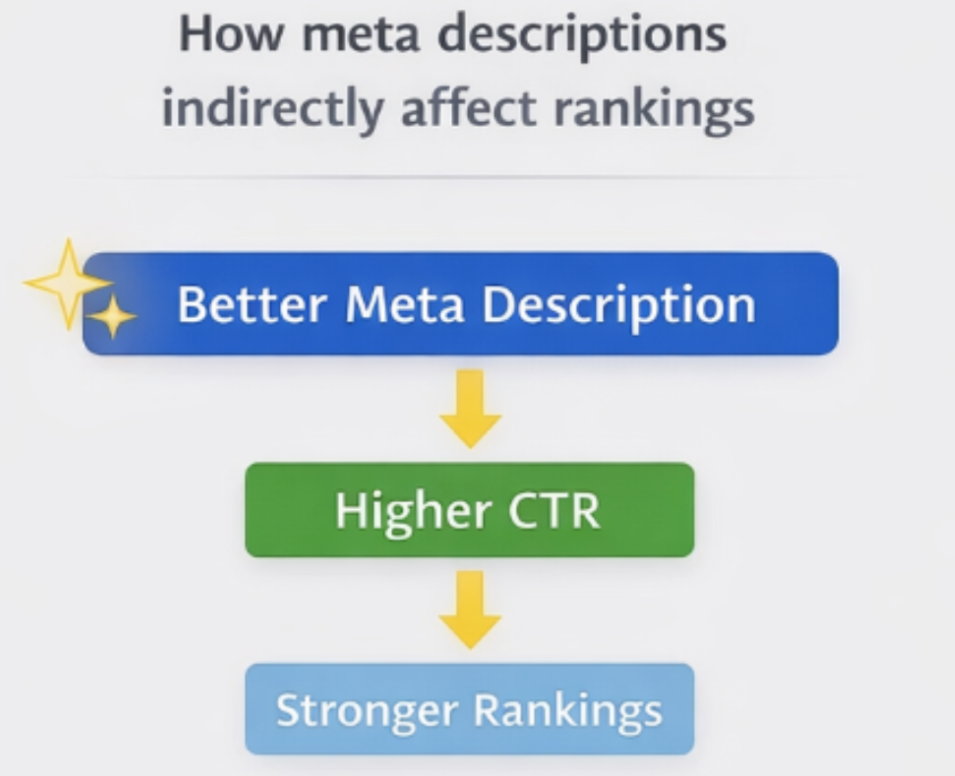
However, saying they do not affect rankings is not the same as saying they do not matter for SEO. The indirect impact is real and measurable.
A well-written meta description influences your click-through rate, which is the percentage of people who see your result and actually click it. According to Incremys, an optimized meta description can increase click-through rate on organic results by 43%. Meanwhile, ClickRank reports that pages with optimized meta descriptions see CTR improvements of 20 to 30% compared to pages with missing or generic descriptions.
Higher CTR sends a signal to Google that users find your result relevant and satisfying. Over time, this behavioral signal can positively influence how Google ranks your page. So while the meta description itself is not a ranking factor, the CTR it drives is a signal that feeds into Google's broader understanding of your page's quality.
There is also the matter of what happens when you do not write one at all. According to AIOSEO, 25% of top-ranking pages are missing meta descriptions entirely. Google then auto-generates a snippet from your page content, which is often awkward, cut off mid-sentence, or simply not the most compelling representation of what your page offers.
Ideal meta description length
Most guides will tell you to keep meta descriptions between 150 and 160 characters. That is the most widely cited range and a reasonable target for desktop search results.
The reality is more nuanced. Like title tags, Google measures meta descriptions in pixels rather than characters. The practical display limit is approximately 430 to 920 pixels depending on the device and screen size. Conductor's research puts the safe range at 70 to 155 characters, while Semrush recommends staying within 135 characters as a practical rule to avoid truncation across all devices.
Mobile is the more important consideration in 2026 given that AIOSEO reports 92.3% of users access the internet using a mobile phone. Mobile search results show significantly less text than desktop, so the safest approach is to put your most important information, your primary keyword and your key benefit, within the first 120 characters. That way even if the description is cut short on a small screen, the essential message still comes through.
Google itself has no official fixed character limit and states that descriptions are simply truncated to fit the device width. The practical guidance is to write concisely, front-load the value, and use tools like the free SERP Snippet Previewer on this site to see exactly how your description will display on both desktop and mobile before you publish.
How to write high-performing meta descriptions
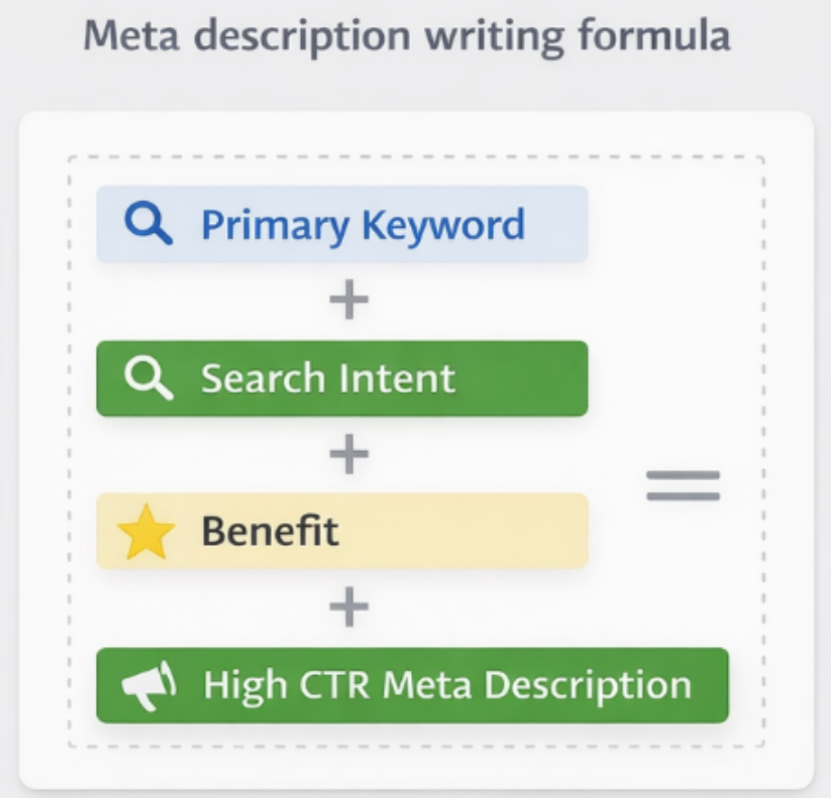
Writing a meta description that earns clicks comes down to four core principles. Each one builds on the last, so it is worth understanding all of them before you start writing.
Match search intent
Before writing a single word, look at the top results for your target keyword and understand what users are actually looking for. Are they trying to learn something, compare options, or make a purchase? Your meta description should speak directly to that intent.
If your page is a beginner guide, the description should signal that clearly so the right readers click and the wrong ones do not. Attracting irrelevant clicks hurts your bounce rate and weakens your user engagement signals.
Use your primary keyword naturally
Google bolds matching keywords in the search snippet when they align with the user's query. This makes your result visually stand out and signals relevance at a glance. Include your primary keyword once where and how you place keywords matters more than how many times you repeat them.
Lead with a clear benefit and add a CTA
Your meta description is competing with every other result on the page for the user's attention. The most effective descriptions answer one question immediately: what will I get if I click this? Focus on the outcome, the benefit, or the problem you solve rather than describing the page in vague terms.
After stating the benefit, add a short call to action. Phrases like "learn how", "find out", "get started", or "see examples" give the reader a clear next step and set expectations for what happens when they click. According to SiteRadar, well-crafted meta descriptions can increase CTR by up to 30% compared to generic or missing ones.
Make each description unique and readable
Every page on your site should have its own meta description. Duplicate descriptions across pages are one of the most common and most avoidable SEO mistakes. According to Sink or Swim Marketing, 50% of websites use duplicate meta descriptions, which dilutes your SEO efforts and gives Google less reason to use your version.
Write in plain, human language. Avoid gimmicky symbols, excessive punctuation, or anything that looks like it was written for an algorithm rather than a person. Google's systems are sophisticated enough to detect low-quality copy, and readers will simply skip past descriptions that feel spammy or robotic.
Good vs bad meta description examples
Here are examples across three different types of pages to show how these principles work in practice.
Page Type | Bad Description | Why It Fails | Good Description | Why It Works |
Blog Post | "This article is about meta descriptions and SEO and how to write them for your website." | Vague, no benefit, keyword stuffed, reads like it was written for a bot | "Learn what meta descriptions are, why they still matter in 2026, and how to write ones that actually earn clicks." | Clear intent, states a benefit, written for a human reader |
Product Page | "We sell running shoes. Buy running shoes online. Best running shoes available." | Repetitive, no differentiator, gives the reader zero reason to choose this result | "Lightweight mens running shoes with cushioned soles. Free shipping on orders over 500 rupees. Shop the 2026 collection." | Specific, benefit-led, includes a conversion hook |
Local Business | "SEO company. We do SEO services for businesses." | Too short, no location, no trust signal, completely forgettable | "Affordable SEO services in Delhi for small businesses. Transparent pricing, monthly reports, and results you can track." | Includes location, targets audience, builds trust with specifics |
Does Google rewrite your meta descriptions
Yes, frequently. As covered earlier, Google rewrites between 60 and 70% of all meta descriptions according to multiple studies. Safari Digital puts the figure at approximately 63%, while some more recent analyses from Portent suggest the number may be as high as 87% in certain niches.
Google rewrites your description when it believes a passage from your actual page content is more relevant to the specific query than what you wrote in your tag. This is not a penalty. It is Google trying to serve the searcher better.
There are things you can do to reduce how often this happens.
Write descriptions that closely match the intent of the keyword you are targeting
Make sure your description genuinely reflects what the page covers rather than being a generic pitch
Put your primary keyword in the description so Google sees intent alignment
Keep your description within the recommended length range so truncation is not the reason for a rewrite
Write your opening paragraph well, since Google often pulls the first paragraph of your content as an alternative snippet when it rewrites your tag
You cannot fully prevent Google from rewriting your descriptions. But pages with clear, intent-aligned, well-written descriptions are far more likely to have their original tag used.
Technical implementation and large sites
How you add a meta description depends on whether you are working directly in HTML or using a CMS. Here is how to do both, along with a practical approach for sites that have too many pages to handle manually.
How to add a meta description in HTML
Place the meta description tag inside the head section of your page, after the title tag:
html
<head>
<title>Your Page Title Here</title>
<meta name="description" content="Your meta description goes here, ideally between 120 and 155 characters." />
</head>
Adding meta descriptions in popular CMS platforms
If you are using WordPress, the Yoast SEO or Rank Math plugins add a dedicated meta description field to every page and post editor. You do not need to touch any code. In Webflow, each page has a meta description field under page settings. In Wix, it is available under SEO settings for each page. Shopify includes it as a search engine listing preview field on every product and page.
Programmatic templates for large sites
If you run a site with hundreds or thousands of pages, writing a unique meta description for every single page manually is not realistic. The practical approach is to build templates for repeating page types and then manually write custom descriptions only for your highest-value pages.
A simple template for a product page might look like: "Shop [Product Name] at [Brand]. [Key Benefit]. Free shipping on orders over [amount]."
For a blog post template: "Learn [Topic] with this [length/type] guide. Covers [key subtopic], [key subtopic], and [key subtopic] with real examples."
Prioritize writing custom descriptions for your homepage, top-traffic landing pages, highest-converting product or service pages, and any pages you are actively trying to rank or improve CTR on. For lower-priority archive pages and thin content pages, a well-structured template is better than a blank tag.
Controlling snippets in Google
Google provides a set of robots meta tags that let you control how your pages appear in search results. These are worth knowing, though they come with real trade-offs.
nosnippet tells Google not to display any snippet for the page at all. The result will show with a title and URL but no description text. This is rarely a good idea for most pages since removing the description makes your result less compelling and almost always lowers CTR.
max-snippet:[number] lets you set a character limit on how long the snippet Google shows can be. For example, max-snippet:100 tells Google to display no more than 100 characters of snippet text. Publishers sometimes use this to protect premium content from being summarized in search results.
data-nosnippet is an HTML attribute you can apply to a specific section of your page content rather than the entire page. It tells Google not to use that particular section of text as snippet material, which can be useful if you have disclaimers, legal text, or other content you do not want appearing as the summary in search results.
Use these tags carefully. Restricting your snippets without a clear reason can reduce your visibility and CTR. Only apply them when you have a specific editorial, legal, or business reason to do so.
Common meta description mistakes
Even well-optimized sites make these errors regularly. Knowing them puts you ahead of the majority of pages competing for the same keywords.
Missing meta descriptions entirely. As noted earlier, 25% of top-ranking pages have no meta description. Google then generates one automatically, which is often poorly representative of the page. Writing even a basic description gives you more control over your search appearance.
Duplicate descriptions across pages. This is the most widespread mistake. With 50% of websites having duplicate descriptions, fixing yours is an immediate competitive advantage. Every page needs a unique description that reflects its specific content and target keyword.
Descriptions that are too short. Pages without custom descriptions or with descriptions under 100 characters waste the opportunity to communicate value. According to ClickRank, pages without custom descriptions typically see 10 to 15% lower CTR compared to pages with well-written ones.
Descriptions that are too long. Going significantly over 160 characters means your description will be cut off mid-sentence in search results, which looks unprofessional and loses the CTA at the end where you most want it.
Keyword stuffing. Cramming multiple keywords into a description makes it unreadable and reduces CTR because real humans can tell immediately that it was written for an algorithm, not for them.
Writing for search engines instead of people. Vague descriptions like "this page contains information about our services" give the reader no reason to click. Focus on what the user will gain, not what the page contains.
Misleading descriptions. If your description promises something the page does not deliver, users will click and immediately bounce. High bounce rates signal poor quality to Google and hurt your rankings over time.
Conclusion
Meta descriptions occupy an interesting position in SEO. They are not a ranking factor, Google rewrites the majority of them, and yet the ones that are used can meaningfully improve your click-through rate and the quality of traffic reaching your pages.
The right approach is not to obsess over every single meta description on your site. It is to write strong, intent-aligned, unique descriptions for your most important pages, use templates for repeating page types at scale, and monitor performance in Google Search Console to identify where rewrites are happening and whether your CTR is below average for your ranking position.
A good meta description is not a guarantee of clicks. But a bad one, or no description at all, is a guarantee of lost ones.
Next step: Read our guide on title tags to understand how the clickable headline above your description works, and how the two elements work together to earn more clicks from the same ranking position.