Not every page competes on the same terms.
Google understands that the consequences of a bad recommendation aren't equal. An inaccurate restaurant review might waste an evening, but incorrect advice about investing, medications, or taxes can have lasting financial, medical, or legal consequences.
That's why Google treats certain topics differently. It calls them Your Money or Your Life (YMYL) pages and holds them to a much higher quality standard than ordinary content.
If your website publishes content about finance, healthcare, law, safety, or other high-impact topics, understanding YMYL isn't optional, it's essential. In this guide, we'll explain what YMYL is, how Google evaluates it, and the best practices for creating content that earns trust and performs well in search.
What is YMYL?
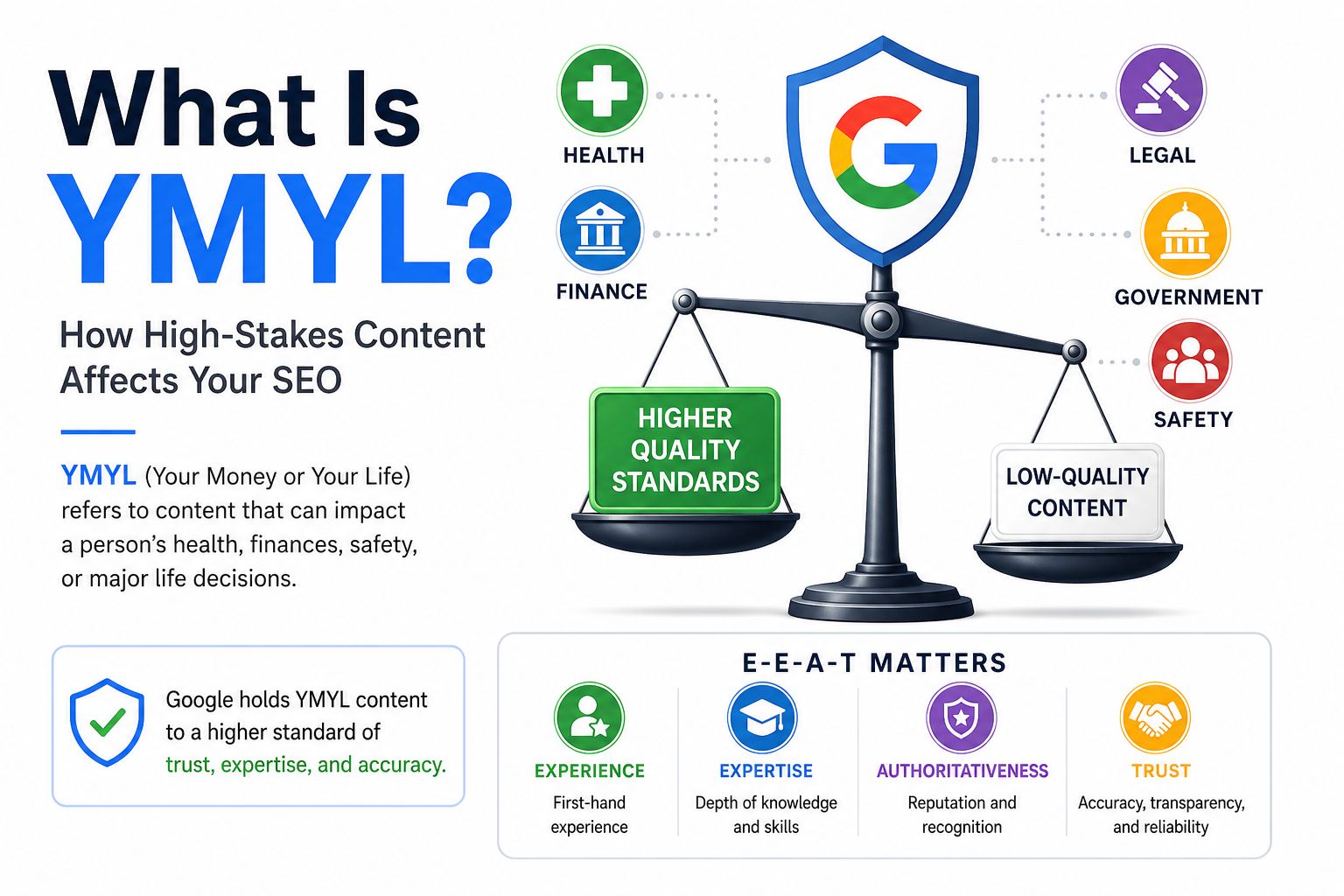
YMYL, short for Your Money or Your Life, is Google's term for content that could significantly affect a person's health, financial stability, safety, or overall well-being.
The concept comes from Google's Search Quality Rater Guidelines, a document used by human quality raters to evaluate the quality of search results. While these raters don't directly influence rankings, their feedback helps Google improve the ranking systems that determine which pages appear in Search.
In simple terms, if inaccurate information could cause real-world harm, Google is likely to treat that page as YMYL and evaluate it more carefully than content on low-risk topics.
YMYL isn't limited to medical websites or banks. A single article about retirement planning, medication side effects, immigration law, or home electrical repairs may qualify as YMYL, even if the rest of the website doesn't. Google evaluates the purpose and potential impact of an individual page, not just the industry it belongs to.
How YMYL Has Evolved
Google introduced the YMYL concept in 2013 and has steadily expanded its scope as Search has evolved.
Earlier versions focused primarily on health and financial advice. Today, YMYL also covers topics such as elections, civic information, public safety, and content that can influence trust in public institutions. The underlying principle, however, has remained the same: the greater the potential for harm, the higher the expectations for quality and trustworthiness.
Why is YMYL important for SEO?
YMYL isn't a direct ranking factor. Google doesn't assign websites a "YMYL score," nor does publishing on a YMYL topic automatically make it harder to rank.
What changes is how Google evaluates quality.
When a search could influence someone's health, finances, safety, or major life decisions, Google's ranking systems place greater emphasis on signals that indicate trust. Pages with accurate information, credible sources, transparent authorship, and genuine expertise are more likely to earn visibility than anonymous or poorly supported content.
This is also why YMYL websites often experience the biggest gains or losses, during major core updates. Google's systems are continually improving at identifying which pages deserve users' trust, particularly for high-impact topics.
The 2018 Medic Update is one of the best-known examples. Although it wasn't limited to healthcare, many websites covering health, finance, and other YMYL topics saw significant ranking changes because Google's quality expectations had become more sophisticated.
For publishers, the takeaway is straightforward: ranking YMYL content requires more than good keyword targeting. It requires demonstrating that your content is accurate, trustworthy, and genuinely helpful to people making important decisions.
Which topics are considered YMYL?
Google doesn't maintain a fixed list of YMYL topics. Instead, it evaluates whether a page could influence decisions that affect a person's health, financial security, safety, or overall well-being. The greater the potential impact, the higher the expectations for accuracy, transparency, and trust.
- Health care
Healthcare is one of the clearest examples. Content about symptoms, medications, treatments, mental health, nutrition, or pregnancy can directly influence medical decisions. Because inaccurate advice may cause real-world harm, Google expects these pages to be factually correct, supported by reliable sources, and reviewed regularly. - Finance
Financial content follows the same principle. Advice about investing, banking, taxes, insurance, loans, retirement planning, cryptocurrency, or cross-border payments can affect how people or businesses manage their money. Publishers covering these topics should focus on helping readers understand their options rather than simply promoting products or services. - Legal and Government
Legal and government content also falls within YMYL because it can influence a person's rights, responsibilities, and access to public services. Immigration guidance, tax obligations, employment law, voting information, and government benefits all require a high degree of accuracy, as outdated or misleading information can lead to costly mistakes. - Shopping and News
Some shopping and news content also qualifies as YMYL, depending on the context. Buying a phone case or reading a movie review is unlikely to have lasting consequences. Choosing a mortgage provider, comparing insurance policies, or following news about public health or financial markets carries much higher stakes. In these cases, readers depend on accurate information to make informed decisions.
The common thread across every YMYL topic isn't the industry, it's the potential for harm. If a reader could lose money, compromise their health, put their safety at risk, or make an important life decision based on the information, Google is likely to apply stricter quality standards.
YMYL examples
The examples below illustrate how YMYL applies across different industries. In each case, the information has the potential to influence important decisions, which is why Google expects a higher level of trust and accuracy.
| Category | Example | Why it's YMYL |
|---|---|---|
| Health | Healthline | Medical advice and treatment information can directly affect a person's health. |
| Finance | Fuze Finance | Content about cross-border payments, OTC crypto desk, digital assets, and financial infrastructure can influence business and financial decisions. |
| Legal | FindLaw | Legal guidance helps readers understand rights, obligations, and legal processes. |
| Government | GovTrack | Information about legislation and voting can shape civic participation and public understanding. |
| Shopping | Zillow | Buying a home or comparing mortgage options involves significant financial commitments. |
| News | Reuters | Reporting on elections, public health, or financial markets can influence major decisions. |
These examples don't mean Google automatically favors large or well-known brands. Smaller publishers can also perform well in YMYL search results, provided they demonstrate expertise, publish accurate information, and earn users' trust over time.
Is every finance or healthcare website automatically YMYL?
Not necessarily.
Google evaluates the purpose of a page, not just the website it's published on.
For example, a fintech company's blog post explaining the history of digital payments is primarily educational. While it's related to finance, it's unlikely to influence a significant financial decision.
A guide comparing international payment methods, explaining foreign exchange costs, or helping businesses choose cross-border payment infrastructure is different. Readers may use that information to decide how they move money globally or which provider they integrate with. Because those decisions have financial consequences, the page is much more likely to be considered YMYL.
The same principle applies to healthcare. An article about the history of vaccines isn't the same as one recommending treatments for a medical condition. Likewise, a travel blog can become YMYL if it provides advice about disease outbreaks or safety risks in a destination.
Rather than thinking of YMYL as a label for entire industries, it's better to think of it as a measure of impact. The more a page can influence important life decisions, the more evidence Google expects that the information is accurate, trustworthy, and created with the user's best interests in mind.
How Google evaluates YMYL content
One of the biggest misconceptions about YMYL is that it's a ranking factor.
It isn't.
Google doesn't assign pages a "YMYL score," nor does it automatically rank websites lower simply because they cover financial, medical, or legal topics.
Instead, YMYL changes how much evidence Google expects before it trusts a page.
For topics where inaccurate information could have serious consequences, Google's systems look more closely at signals that indicate quality and reliability. That includes who created the content, whether the information is accurate and well-supported, how trustworthy the website appears, and whether users can confidently rely on what's published.
This is why ranking YMYL content often feels more challenging than ranking content in less sensitive industries. It's not because Google penalizes YMYL pages, it's because the standard for demonstrating trust is significantly higher.
The role of Google's Search Quality Raters
Google uses thousands of human Search Quality Raters to evaluate the quality of search results.
These raters don't decide where pages rank, and they can't manually improve or lower a website's position in Search.
Instead, they evaluate search results using Google's Search Quality Rater Guidelines. Their assessments help Google understand whether its ranking systems are surfacing pages that are genuinely helpful, trustworthy, and relevant. Google then uses that feedback to improve future algorithm updates.
For YMYL topics, raters are instructed to apply particularly high standards because inaccurate information can lead to real-world harm. A page giving investment advice or explaining medical treatments is evaluated much more critically than one reviewing a smartphone or sharing a travel itinerary.
Think of the raters as quality testers rather than judges. They don't determine rankings directly, but they help Google measure whether its algorithms are rewarding the right kinds of content.
Why some YMYL sites are hit harder by core updates
If you've worked in SEO for a while, you've probably noticed that healthcare, finance, and legal websites often see the biggest ranking swings during Google's core updates.
That's because core updates are designed to improve how Google evaluates content quality overall. When Google becomes better at identifying trustworthy information, YMYL websites tend to feel the impact first because the expectations are already much higher.
The 2018 Medic Update is a well-known example. Although it wasn't exclusively targeted at healthcare websites, many sites publishing medical and financial content experienced significant ranking changes. Pages with weak sourcing, unclear authorship, or questionable expertise often lost visibility, while publishers demonstrating stronger trust signals generally performed better.
Since then, Google's core updates have continued to refine how quality is assessed, making trust and accuracy increasingly important for YMYL content.
YMYL and E-E-A-T
If YMYL defines which topics require greater scrutiny, E-E-A-T explains how Google evaluates their quality.
E-E-A-T stands for Experience, Expertise, Authoritativeness, and Trust. While these principles are useful for every website, they become especially important when content influences decisions about health, money, safety, or legal matters.
Of the four, Trust is the most important. Google has repeatedly stated that the other elements ultimately contribute to helping users determine whether a page is trustworthy.
Experience
Experience refers to first-hand knowledge of a topic.
Readers are more likely to trust content created by someone who has actually used a product, worked through a process, or solved the problem they're writing about. Original screenshots, practical examples, case studies, and real-world insights all help demonstrate experience.
For example, a guide explaining international payment operations becomes more valuable when it's written from the perspective of teams that build or manage payment infrastructure rather than simply summarizing information found elsewhere.
Expertise
Expertise is about having the knowledge required to explain a subject accurately.
The level of expertise Google expects depends on the topic. A travel itinerary doesn't require the same qualifications as an article explaining tax regulations or prescribing medical treatments.
For YMYL content, readers should be able to understand why the author is qualified to write about the subject, whether through professional credentials, industry experience, or demonstrable expertise.
Authoritativeness
Authoritativeness reflects reputation.
It answers questions like:
- Is this website recognized within its industry?
- Do other reputable sources reference it?
- Has the author built credibility in this field?
Authority isn't established by claiming expertise, it's earned over time through consistently publishing reliable content and becoming a trusted source within a particular niche.
Trust
Trust brings everything together.
Accurate information, transparent sourcing, clear author information, accessible contact details, secure browsing, and honest editorial practices all contribute to making a page trustworthy.
For YMYL content, trust also means acknowledging uncertainty where appropriate. Rather than making exaggerated claims or promising guaranteed outcomes, trustworthy content explains limitations, cites reliable evidence, and helps readers make informed decisions.
Ultimately, Google's goal isn't simply to reward experts, it's to reward content that users can confidently rely on when making important decisions.
Best practices for creating high-quality YMYL content
Creating high-quality YMYL content is less about optimizing for search engines and more about earning your readers' trust. Here are the practices that matter most:
- Prioritize accuracy. Verify every statistic, claim, and recommendation before publishing, and review content regularly to ensure it stays current.
- Cite authoritative sources. Support your content with government websites, peer-reviewed research, official documentation, and recognized industry sources.
- Be transparent about authorship. Include author bios, credentials, publication dates, update dates, and editorial policies so readers know who created the content.
- Demonstrate first-hand experience. Add original research, case studies, screenshots, examples, or real-world insights instead of simply summarizing existing content.
- Educate before you sell. If you're publishing product-led content, focus on helping readers understand the topic before introducing your solution.
- Provide balanced information. Explain benefits, limitations, risks, and trade-offs rather than presenting your product or service as the only option.
- Strengthen website trust signals. Maintain a secure website, clear contact information, transparent company details, and accessible legal and privacy pages.
- Keep content updated. Review pages covering fast-changing topics like finance, healthcare, regulations, and technology to ensure information remains accurate.
Common YMYL mistakes to avoid
Even well-written YMYL content can struggle if it lacks credibility. Avoid these common mistakes:
- Publishing generic content that adds little value beyond what's already available online.
- Making unsupported claims without citing reliable or authoritative sources.
- Using anonymous or unqualified authors for topics that require subject-matter expertise.
- Allowing content to become outdated, especially for finance, healthcare, legal, or regulatory topics.
- Over-promoting products or services instead of providing objective, educational information.
- Ignoring transparency, such as missing author information, editorial policies, or company details.
- Publishing AI-generated content without human review. AI can speed up research and drafting, but every YMYL page should be fact-checked and reviewed by someone with relevant expertise before publication.
- Neglecting user trust. Poor website security, unclear contact information, or a lack of credibility signals can undermine confidence in otherwise good content.
Conclusion
YMYL isn't about giving larger brands an unfair advantage or making SEO impossible for smaller publishers. It's Google's way of protecting users when they're searching for information that could influence their health, finances, safety, or future.
If your content helps people make important decisions, accuracy and trust should never be treated as optional. Publishing well-researched information, citing reliable sources, demonstrating expertise, and being transparent about who created the content are all part of building long-term credibility.
Ultimately, the best YMYL content isn't the content that tries hardest to rank. It's the content that gives readers enough confidence to make informed decisions, and that's exactly the kind of content Google aims to reward.


![What is Conversion Rate Optimization in AI search [2026]](https://cdn.sanity.io/images/cjp3nw01/production/cd66159971e24090347c156ab261051389e40d8a-1200x628.png)