LLM visibility is not just a marketing problem. It is a technical problem. Whether your brand appears in ChatGPT, Perplexity, Claude, and Google AI Overviews depends on decisions made in your robots.txt file, your schema implementation, your server rendering configuration, your documentation architecture, and your content management system — not just the blog posts your content team publishes.
This guide covers every technical layer of LLM visibility implementation: crawler access, server rendering, schema markup, content architecture, API accessibility, and measurement — organized as a step-by-step workflow your team can execute systematically.
Why LLM visibility is a technical problem
Most LLM visibility guides focus on content strategy: write better content, earn more mentions, build entity authority. Those things matter. But they produce no results if the technical layer underneath them is broken. An AI crawler that cannot access your pages, a JavaScript-rendered page that appears blank to a retrieval bot, a missing schema type that leaves your content unattributed, or a hallucinated URL that sends AI-referred users to a 404 — each of these is a technical failure with direct visibility consequences.
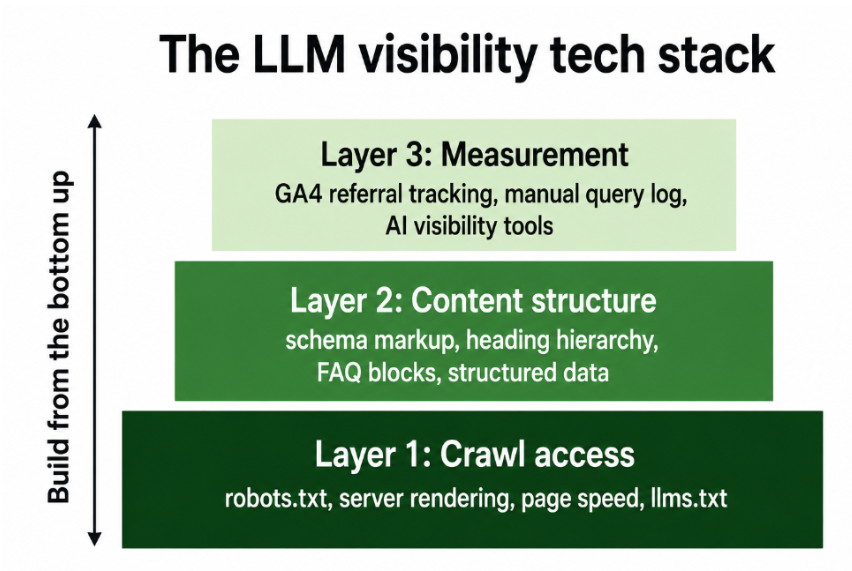
The technical dimension of LLM visibility covers three distinct systems: the crawl access layer that determines whether AI systems can reach your content, the content structure layer that determines whether AI systems can parse and extract it accurately, and the measurement layer that determines whether you can observe and iterate on your visibility performance. All three must work for LLM visibility to compound as intended.
Step 1: configure AI crawler access in robots.txt
Before any other optimization, confirm that AI retrieval bots can access your content. This is the single most foundational step and the one most frequently misconfigured. Many sites added broad AI disallow rules in 2024 to prevent training data scraping and accidentally blocked the retrieval bots that determine AI search citation eligibility at the same time.
The major AI platforms each operate multiple crawlers with distinct functions. Training bots collect content for model development. Retrieval and search bots index content for real-time AI search responses. Blocking all bots from a platform eliminates both functions simultaneously. The correct approach is to evaluate each bot by function:
| Bot | Platform | Function | Block impact on AI visibility |
|---|---|---|---|
| GPTBot | OpenAI | Training data | No direct visibility impact — excludes from future training only |
| ChatGPT-User | OpenAI | Real-time retrieval | Blocks real-time citation — direct negative impact |
| ClaudeBot | Anthropic | Training data | No direct visibility impact |
| Claude-SearchBot | Anthropic | Search indexing | Removes site from Claude search index — high impact |
| PerplexityBot | Perplexity | Search indexing and retrieval | Blocks all Perplexity citations — direct negative impact |
| GoogleBot | Search indexing | Blocks all Google search visibility including AI Overviews |
The recommended configuration for publishers who want full AI citation visibility while opting out of training data collection:
User-agent: GPTBot
Disallow: /
User-agent: ClaudeBot
Disallow: /
User-agent: ChatGPT-User
Allow: /
User-agent: Claude-SearchBot
Allow: /
User-agent: PerplexityBot
Allow: /
Review your current robots.txt against this framework. If you added blanket AI disallow rules previously, audit which specific bots they cover and update to the per-bot configuration above. Validate your robots.txt using Google Search Console's robots.txt tester after any changes. The full robots.txt configuration guide is at robots.txt guide.
Step 2: implement server-side rendering for critical content
AI crawlers do not execute JavaScript. Content that is rendered client-side through React, Vue, Angular, or any JavaScript framework is invisible to AI retrieval systems even when it displays correctly in a user's browser. This includes your page's body text, internal links, headings, and structured data if any of them are injected by JavaScript rather than present in the initial HTML response from the server.
Audit your critical pages by comparing the raw HTML response from the server against the fully rendered page in a browser. Use your browser's developer tools to view the page source (not inspect the DOM) — the page source shows what the server delivered before JavaScript ran. If your H1, body paragraphs, or main content are absent from the page source, they are being client-side rendered and are invisible to AI crawlers.
The fix is server-side rendering (SSR) or static site generation (SSG) for all content that needs to be accessible to AI systems. This applies to body text, main navigation, internal links, and all structured data. JavaScript is appropriate for interactive elements, user interface components, and dynamic features that do not affect content discovery.
Step 3: implement comprehensive schema markup
Schema markup is the primary mechanism through which AI systems understand what your content contains, who created it, when it was published, and how to attribute it accurately in generated answers. Without schema, AI systems must infer all of this from unstructured text — a process that produces inconsistent, sometimes inaccurate results. With schema, you provide explicit machine-readable declarations that AI systems can process with certainty.
Priority schema types for LLM visibility based on analysis of 2 million LLM sessions:
- Article schema: Declares the content type, headline, author, publication date, and publisher. Every editorial page should have this. Include the author's name, credentials, and profile URL to strengthen E-E-A-T signals.
- FAQ schema: Labels Q&A pairs explicitly. FAQ sections are among the most frequently extracted content types in AI-generated answers because they match the question format of user queries directly.
- HowTo schema: Labels step-by-step guides so AI systems can extract individual steps as citation units rather than treating the guide as an undifferentiated block of text.
- Organization schema: Declares your brand's canonical name, description, logo, social profiles, and contact information. This is the primary entity signal for brand identity in AI systems.
- Person schema: For named authors and subject-matter experts. Connects author credibility signals to the content they produce.
- Product schema: For product pages with pricing, availability, and reviews. Enables AI agents evaluating and recommending products to extract structured attributes accurately.
Validate all schema implementations using Google's Rich Results Test before deploying. For the full schema strategy aligned with AI retrieval, the structured data for LLMs guide covers implementation for every content type.
Step 4: structure content for passage-level extraction
AI systems extract content at the passage level, not the page level. Each section of your page is evaluated independently as a potential citation source for a specific sub-query. The technical content structure decisions that make pages extractable are:
- Answer-first sections: Every H2 and H3 section should open with a direct, self-contained answer to the question the heading implies. Sections that build context before delivering the answer are skipped during AI extraction in favor of sections that answer immediately.
- Semantic HTML: Use proper semantic HTML5 elements (article, section, main, aside, header, footer) rather than generic div containers. AI crawlers and language models process semantic structure, not visual layout, to understand content hierarchy.
- Short paragraphs (2 to 4 sentences): Each paragraph should make one point. Short, focused paragraphs are cleaner extraction units than dense multi-idea paragraphs.
- Question-based headings: H2 and H3 headings phrased as questions align directly with the sub-query format that AI systems generate during query fan-out. A heading that reads 'What is schema markup?' is more extractable for the query 'what is schema markup?' than one that reads 'Schema overview'.
- FAQ blocks: Add a FAQ section to every comprehensive guide, structured with explicit question-and-answer pairs and FAQ schema markup. These blocks are designed for extraction and consistently appear in AI-generated answers.
Step 5: optimize your documentation and API references
For technical products, SaaS tools, developer platforms, and any site where developers are the target audience, documentation quality is one of the strongest LLM visibility signals available. AI search engines favor earned media and third-party sources over brand-owned content, but well-structured, comprehensive documentation on your own domain is cited heavily because it is the primary authoritative source for technical questions about your specific product. Sparse, incomplete, or poorly structured documentation produces inaccurate AI descriptions of your product — the exact problem that is hardest to correct once AI systems have encoded an inaccurate understanding.
Documentation pages should be structured as semantic HTML, not PDF, where possible. Every API endpoint, feature, and concept should have its own URL so AI systems can cite specific documentation pages rather than generic domain references. Code examples should be in code blocks with proper language declarations. Version numbers and release dates should be visible and up to date.
Step 6: build off-site citation presence
Technical infrastructure enables AI crawlers to access and understand your content. Off-site presence determines how often AI systems choose to cite it. LLMs are trained on and retrieve from a much broader web ecosystem than your own site, and the sources they weight most heavily are third-party authoritative publications, community platforms, and user-generated content sites.
The platforms with the highest citation weight for AI systems across most industries are Reddit, Quora, Wikipedia, Stack Overflow (for developer tools), YouTube, and high-authority industry publications. Building genuine presence on these platforms — through helpful community participation, expert content contributions, and earned editorial coverage — creates the citation base that AI systems draw from when forming recommendations and answers about your topic area.
For developer tools specifically, Stack Overflow answers in your tool's category, GitHub README optimization for evaluators rather than existing users, and appearances in "awesome" lists and comparison articles on third-party developer blogs are among the highest-impact off-site activities available. The digital PR guide and brand mentions guide cover the broader off-site visibility strategy.
Step 7: implement LLM visibility measurement
Without measurement, you cannot iterate. LLM visibility measurement requires three parallel systems because no single tool covers the full picture:
GA4 referral traffic monitoring
In Google Analytics 4, create a custom segment for sessions originating from AI platform domains: chatgpt.com, perplexity.ai, claude.ai, gemini.google.com, and copilot.microsoft.com. Monitor this segment weekly for volume, engagement rate, pages per session, and conversion rate. Track 404 errors from these referral sources separately — AI platforms hallucinate URLs regularly, and 404 errors from AI-referred traffic represent high-intent visitors landing on broken pages.
Monthly manual query log
Select fifteen to twenty prompts central to your product category and run them monthly across ChatGPT, Perplexity, Claude, and Google AI Mode. Record brand appearance, citation URL, competitor mentions, and any inaccuracies in how your brand is described. This manual log is the most reliable method for detecting AI hallucinations, tracking narrative accuracy, and identifying content gaps that competitors are filling.
Dedicated AI visibility tools
Platform-specific tracking tools automate what manual testing can only sample. Serplock tracks how AI models perceive your brand across platforms and supports content optimization for more mentions. Semrush One and SE Ranking's AI Search add-on provide keyword-level visibility tracking across multiple AI platforms with daily updates. Ahrefs Brand Radar tracks brand citation frequency and share of voice.
Common technical LLM visibility mistakes
| Mistake | Impact | Fix |
|---|---|---|
| Broad AI disallow in robots.txt | Blocks retrieval bots alongside training bots — eliminates citation eligibility | Configure per-bot: allow ChatGPT-User, Claude-SearchBot, PerplexityBot; evaluate training bots separately |
| JavaScript-rendered critical content | Body text invisible to all AI crawlers regardless of content quality | Implement SSR or SSG for all content that needs AI visibility |
| Missing schema markup | AI systems must infer content type, authorship, and structure from unstructured text — producing inconsistent results | Implement Article, FAQ, HowTo, Organization, and Person schema across all relevant pages |
| Sparse or unstructured documentation | AI systems produce inaccurate or incomplete product descriptions — hardest problem to correct after encoding | Audit documentation for completeness. Every feature, endpoint, and concept needs its own URL and clear structure |
| No 404 monitoring from AI referrals | Hallucinated URLs from AI platforms send high-intent users to broken pages | Monitor GA4 for 404 errors from AI platform referral sources monthly and implement 301 redirects |
| Measuring only organic traffic volume | AI-referred traffic is small in volume but high in conversion intent — volume metrics alone miss the channel value | Create dedicated GA4 segments for AI referral traffic and track conversion rate separately |
Conclusion
LLM visibility is built in layers: crawler access first, then content structure, then off-site presence, then measurement. Each layer is a prerequisite for the next. Content that cannot be accessed cannot be extracted. Content that cannot be extracted cannot be cited. Citations that cannot be measured cannot be improved.
The technical steps in this guide — robots.txt configuration, server-side rendering, schema implementation, semantic content structure, documentation quality, and off-site presence building — are the foundation of everything covered in the broader LLM visibility strategies guide. Start with the crawler access layer, audit your rendering configuration, validate your schema implementation, and build measurement before optimizing content. That sequence produces compounding returns far faster than content optimization on a broken technical foundation.
![What is Conversion Rate Optimization in AI search [2026]](https://cdn.sanity.io/images/cjp3nw01/production/cd66159971e24090347c156ab261051389e40d8a-1200x628.png)