Every few months a new wave of content declares traditional SEO dead. AI is replacing search. Zero-click results are absorbing all the traffic. Generative answers have made rankings irrelevant. The headlines are dramatic. The data tells a different story.
This guide explains what traditional SEO means, the core tactics it covers, how those tactics have evolved, what traditional SEO cannot do on its own in 2026, and how it fits alongside newer disciplines like AEO and GEO.
What traditional SEO means
Traditional SEO is the practice of optimizing a website to rank higher in organic search engine results pages, primarily on Google and Bing. It encompasses the full range of on-page, technical, and off-page practices that signal to search engines that a page is relevant, authoritative, and worth surfacing for specific queries.
The term "traditional" distinguishes this discipline from newer AI-driven optimization approaches. Traditional SEO targets the classic blue-link results: ranked pages that users click through to visit your website. It is built around keyword rankings, organic traffic, and domain authority as its primary performance metrics.
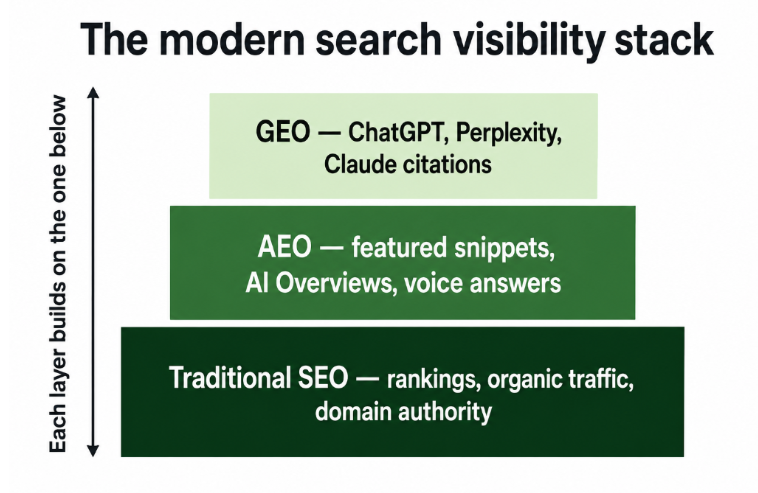
What makes it foundational rather than obsolete is that the signals traditional SEO builds are the same signals that newer AI-driven systems evaluate. 97% of AI Overview citations come from pages already ranking in the top 20 organic results. Traditional SEO is the layer beneath everything else. Strong traditional SEO makes AEO and GEO work better. Weak traditional SEO makes both of those disciplines nearly impossible.
The core components of traditional SEO
Keyword research and targeting
Traditional SEO starts with understanding what your target audience is searching for. Keyword research identifies the specific phrases users type into search engines, evaluates their search volume, competitive difficulty, and the intent behind them, and maps them to a content architecture that can realistically capture that traffic.
In 2026, keyword research has grown more nuanced. Exact-match keyword targeting has given way to topic-based and intent-based targeting, where the goal is to cover a subject area comprehensively through interconnected content clusters rather than optimizing individual pages for single phrases. The keyword research guide covers the full process for modern keyword research that works across both traditional rankings and AI-generated answers.
On-page SEO
On-page SEO covers all the optimization done within the page itself: the title tag, meta description, heading structure, content quality, keyword placement, internal linking, image optimization, and structured data markup. These elements communicate relevance to search engines and determine whether a page matches the intent of a target query well enough to rank.
Google's helpful content system has raised the standard for what on-page SEO means. It is no longer sufficient to include a keyword in the right places and write a long enough article. Pages must demonstrate genuine expertise, cover topics with real depth, and satisfy the user's underlying need rather than just matching their search phrase. The full on-page SEO framework is in the on-page SEO guide.
Technical SEO
Technical SEO ensures that search engines can find, access, crawl, index, and understand every important page on a site. It covers site speed and Core Web Vitals, HTTPS security, mobile optimization, XML sitemaps, robots.txt configuration, canonicalization, structured data implementation, and site architecture. In 2026, technical SEO has expanded to include AI crawler management — configuring access for GPTBot, Claude-SearchBot, and PerplexityBot alongside traditional search bots.
Technical SEO is the most stable component of the discipline. The fundamentals — crawlability, indexing, page speed, clean architecture — have remained consistent for years. What changes is the scope. The technical SEO guide covers the full foundation including AI crawler considerations.
Off-page SEO and link building
Off-page SEO builds the external authority signals that tell search engines a site is trustworthy and worth ranking prominently. Backlinks from relevant, high-authority external sites remain the strongest off-page signal. Brand mentions, digital PR coverage, review platform presence, and community participation all contribute to the entity authority that underpins both traditional rankings and AI citation visibility.
Link building in 2026 is fundamentally editorial. Links earned through genuinely useful content, expert commentary, original research, and digital PR consistently outperform links acquired through mass outreach or link schemes. The link building guide and off-page SEO guide cover both the strategic and tactical dimensions.
How traditional SEO has evolved in 2026
| Traditional SEO then | Traditional SEO now (2026) |
|---|---|
| Keyword density as a ranking signal | Semantic topic coverage and topical depth |
| Targeting individual keywords with single pages | Topic clusters with pillar pages and supporting subtopic pages |
| Links from any domain boosted rankings | Only topically relevant, editorially earned links from quality domains |
| Title tag optimization for exact-match phrases | Intent-matched titles that answer user questions and improve CTR |
| Content length as a proxy for quality | Genuine depth, expertise, and E-E-A-T as quality measures |
| Technical SEO focused only on Google | Technical SEO covers Google, Bing, and AI platform crawlers |
| Rankings and traffic as primary metrics | Rankings, traffic, engagement quality, and AI citation rate |
What traditional SEO still does better than anything else
Despite the rise of AI-driven search features, traditional organic rankings remain the highest-volume discovery channel for most websites by a significant margin. Traffic from a top-three Google ranking for a commercial keyword typically dwarfs traffic from AI citations or voice answers for the same query. For businesses that depend on consistent organic traffic at scale, traditional SEO is not an optional layer. It is the core channel.
Traditional SEO also produces the most durable returns of any digital marketing investment. A well-ranked page continues to drive traffic for months or years after the initial optimization work is done, without ongoing ad spend. The SEO services market is growing to $83.98 billion in 2026 precisely because this durability is more valuable in a world of rising paid media costs. Pages that rank and hold their positions are assets, not expenses.
It also remains the strongest signal source for AI-driven features. Google AI Overviews draw their citations heavily from pages in the top 20 organic results. ChatGPT Search and Perplexity retrieve content from pages that are both high-authority and technically accessible. Traditional SEO builds the domain authority and content quality that make a site eligible for these AI-driven placements in the first place.
Where traditional SEO falls short in 2026
The honest limitation of traditional SEO in 2026 is zero-click erosion. Over 60% of all Google searches now end without a click, with AI Overviews and featured snippets answering queries directly on the results page. A site can rank number one for an informational query and receive significantly less traffic than it would have three years ago for the same position, because the AI Overview above it is satisfying the query before users scroll to the organic results.
This is not a reason to abandon traditional SEO. It is a reason to extend it. Pages that rank in the top ten are the same pages that appear in AI Overviews, get cited by ChatGPT, and appear in Perplexity responses. Traditional SEO is the foundation. AEO and GEO are the layers that ensure those rankings convert into visibility across every format the modern search results page contains. The AEO vs GEO vs SEO guide explains how the three disciplines work together.
The traditional SEO tactics that still work in 2026
| Tactic | Why it still works | 2026 update |
|---|---|---|
| Keyword research and intent mapping | User demand is still the foundation of every content decision | Now includes question-based discovery for AI sub-query coverage |
| Title tag and meta description optimization | CTR improvement from better titles directly affects ranking stability | AI systems use title tags to attribute content in generated answers |
| Internal linking and topic clusters | Distributes authority and signals topical depth across the site | Cluster architecture is the primary structure AI systems use for topical authority evaluation |
| Backlink acquisition through digital PR | Domain authority remains a top-three ranking factor | Same editorial links also feed AI citation footprint and entity authority |
| Technical SEO: speed, crawlability, structure | Pages that cannot be accessed or indexed cannot rank | Now covers AI crawlers alongside traditional search bots |
| E-E-A-T signals: authorship, citations, freshness | Google's quality systems reward demonstrable expertise and trustworthiness | Same signals that determine AI citation selection and LLM visibility |
| Structured data and schema markup | Enables rich results and reduces ambiguity about content type | Directly supports AI retrieval systems evaluating page content |
Common misconceptions about traditional SEO in 2026
Misconception: Traditional SEO is dead. Wrong. Google still handles the overwhelming majority of search traffic. SEO generates an 8x ROI. The SEO services market is growing to $148 billion by 2031. Traditional SEO is evolving, not dying.
Misconception: AI will replace search engines. Not imminently. ChatGPT represents 17.1% of digital queries. Google handles 77.9%. Search behavior is fragmenting across platforms, but Google's dominance remains decisive for most industries and content types.
Misconception: Rankings no longer matter because of zero-click. Rankings still matter because they determine AI Overview inclusion, ChatGPT retrieval, and Perplexity citation eligibility. Zero-click reduces direct traffic from a ranking; it does not eliminate the value of holding the ranking.
Misconception: Traditional SEO and AI search optimization are separate strategies. They are layered strategies. Strong traditional SEO is the prerequisite for appearing in AI-generated answers. AEO and GEO build on top of a traditional SEO foundation, they do not replace it.
Conclusion
Traditional SEO is the foundation of digital visibility in 2026. The tactics it covers — keyword research, on-page optimization, technical infrastructure, and off-page authority building — remain the mechanisms through which pages earn the rankings, domain authority, and content quality that all other discovery channels build on. AI search visibility is not an alternative to traditional SEO. It is an extension of it.
The brands winning in 2026 are those that have not abandoned traditional SEO in favor of AI-only strategies, but have built on it deliberately. They have used strong SEO foundations to establish rankings, layered AEO practices to capture AI Overview placements, and invested in GEO through off-site brand building to earn LLM citations. The full strategy is covered in the LLM visibility strategies guide. Traditional SEO is where every one of those strategies begins.


![What is Conversion Rate Optimization in AI search [2026]](https://cdn.sanity.io/images/cjp3nw01/production/cd66159971e24090347c156ab261051389e40d8a-1200x628.png)